
Published by Johny Metal Recycling | August 2026
Most people hand over their scrap metal at a facility or have it collected from site, and that’s essentially the end of their involvement. What happens after that point is genuinely worth understanding, especially if you’re a business that regularly generates scrap or someone trying to get a fair payout for a load of copper, aluminium, or old steel.
Metal recycling in Melbourne is a structured, multi-step process. From the moment your metal leaves your hands, it moves through sorting, classification, processing, and then either local reprocessing or export into global commodity markets. Each step affects the value of what you hand over and the environmental outcome it delivers.
This article walks you through exactly what happens at each stage, so you know where your scrap ends up, why sorting matters before you drop off, and how to get more from the process whether you’re a household, a tradie, or running a factory clearout.
Step 1: How Scrap Metal Enters the Recycling Chain in Melbourne
Metal enters the recycling system through a few different pathways. Which one applies to you depends on how much you have, where you are, and what type of metal it is.
Drop-Off: The Most Common Starting Point
For most households and small businesses, dropping scrap directly at a recycling facility is the most straightforward option. You bring your load in, it gets weighed on arrival, and you receive a payout based on the type and weight of metal you’ve delivered.
Drop-off facilities across Melbourne operate under varying hours and locations. Some run Monday to Saturday, with weekend hours often finishing earlier than weekday hours, which is worth factoring in if you’re working around job sites or business schedules. Geography matters too. A facility in the inner south-west might work well for businesses in that area but add unnecessary travel time for those based further east or north.
The advantage of drop-off is speed and simplicity. You control the timing, and if your load is well sorted, the assessment process moves much faster.
Collection Services: When the Metal Comes to You
For larger volumes or bulky items that can’t easily be transported, collection is the more practical option. Many Melbourne recyclers offer free pick-up for homes and businesses, particularly when the quantity or weight of metal makes the trip commercially worthwhile for both parties.
As a general rule, large and bulky items like structural steel, old machinery, or a significant volume of copper pipe are more likely to qualify for free collection than a mixed bag of smaller pieces. Volume and weight are the deciding factors, not just the metal type. If you’re unsure, it’s worth calling ahead before arranging anything.
Some recyclers also provide on-site collection bins in various sizes for commercial and industrial sites. These can be left on-site and swapped out once full, which suits businesses that generate scrap regularly but don’t have the logistics to transport it themselves. You can find out more about scrap metal collection in Melbourne and whether your volume qualifies for free pick-up.
Industrial and Commercial Clearances: A Different Beast Entirely
Factory decommissioning and large-scale industrial cleanouts sit in a separate category from standard drop-off or collection. These jobs involve mixed metals, machinery frames, shelving, structural steel, cables, and pipework, often in large volumes that require careful planning, equipment, and on-site sorting before anything can be loaded and processed.
This kind of job isn’t just about scrap value. It’s also about safely removing equipment, stripping materials from a building, and leaving a site clear. The logistics are more complex, timelines are longer, and the mix of materials needs careful handling because different metals carry different values and processing requirements.
For businesses going through a factory clearout or end-of-lease situation, working with a recycler that has genuine experience in industrial clearances makes a significant difference to both the outcome and the ease of the process. At Johny Metal Recycling, we’ve handled factory clearouts across Melbourne ranging from 5 tonnes of mixed structural steel to well over 50 tonnes of combined ferrous and non-ferrous material across multi-building sites. The planning and equipment required for those jobs is a world away from a standard collection run, and getting that experience on your side from the start saves considerable time and avoids surprises.
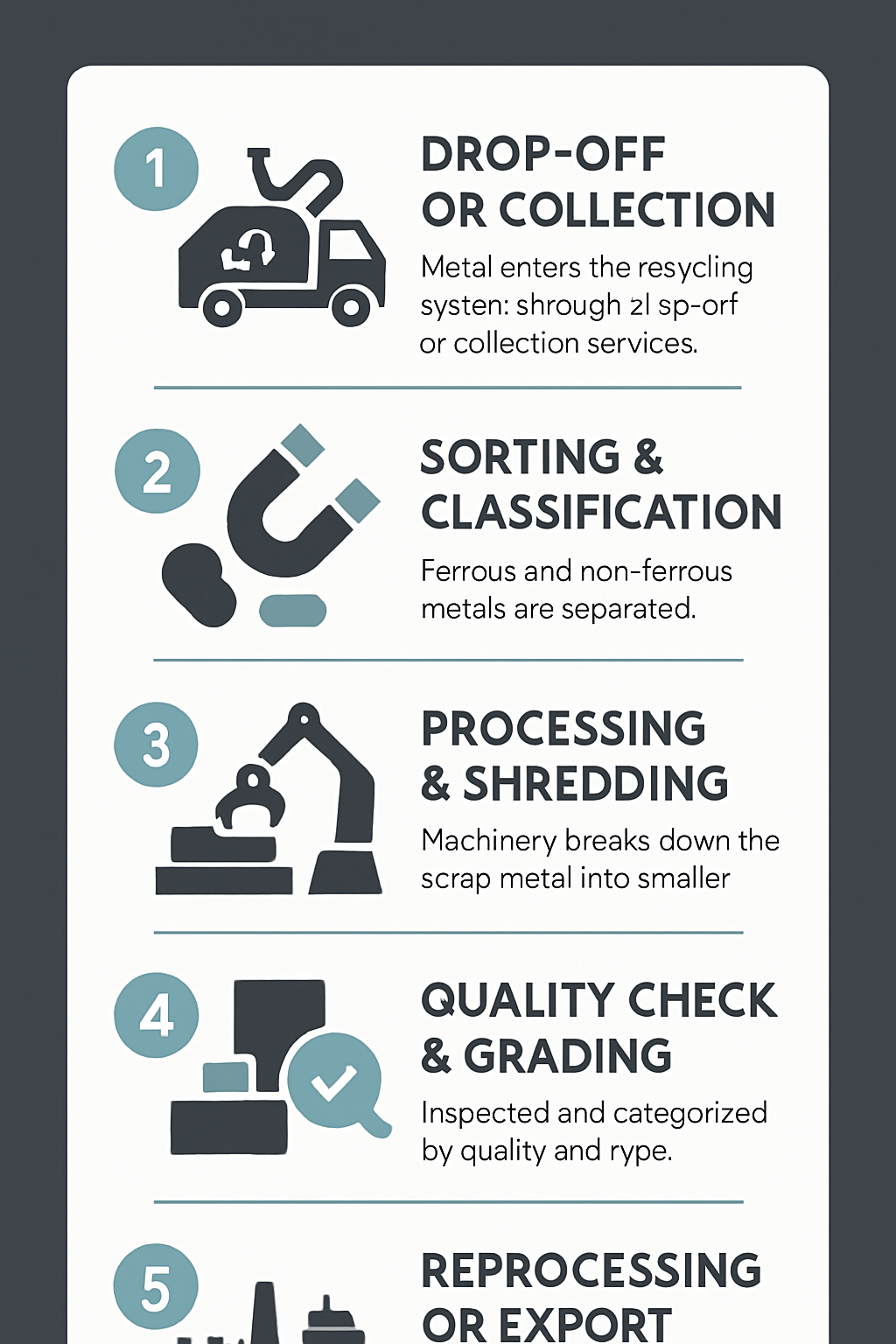
Step 2: Sorting and Classification at the Facility
Once your scrap arrives at the facility, whether you dropped it off or it was collected, it goes through sorting and classification before any processing begins.
Ferrous vs Non-Ferrous: Why the Distinction Matters
The first and most fundamental sorting step is separating ferrous metals from non-ferrous metals. Ferrous metals contain iron, think steel and cast iron. Non-ferrous metals don’t contain iron, and this group includes aluminium, copper, brass, stainless steel, and lead.
The distinction matters for several reasons. Ferrous and non-ferrous metals have different values, different processing requirements, and different end markets. Non-ferrous metals like copper and aluminium are generally worth more per kilogram and require more careful handling during processing. Ferrous metals are higher volume but lower per-kilogram value, and they move through different equipment entirely.
Understanding this difference helps explain why a mixed load often pays less than separated metal. We’ve covered this in detail in our guide to ferrous and non-ferrous metals explained.
How Mixed Loads Are Sorted
Mixed loads, which are common in residential drop-offs and factory cleanouts, require additional time and labour to work through. Magnets are the first tool used at most facilities. A magnet quickly identifies ferrous metals because they’re drawn to it, while non-ferrous metals don’t respond at all.
From there, trained staff visually inspect the material. Copper looks like copper. Aluminium has a distinct weight and appearance. Brass carries a different colour. Stainless steel doesn’t rust and has a particular sheen. Experienced sorters can work through a load quickly, but the more mixed and contaminated a load is, the longer it takes, and that time gets factored into what you’re paid.
Grading and Contamination Checks
Not all copper is the same, and not all aluminium is the same either. Once sorted by type, metals are graded further. Bright, clean copper wiring is worth more than copper that’s heavily insulated or corroded. Clean aluminium sheeting is worth more than painted or coated aluminium with non-metal attachments still on it.
Electronic testing equipment is used for high-value non-ferrous metals to verify grade and purity, particularly when dealing with industrial quantities. Contamination checks also look for non-metal materials mixed in with the scrap, such as plastic fittings left on copper pipe or rubber attached to metal components. These need to be removed or discounted before pricing is confirmed.
Step 3: Processing: Shredding, Baling, and Preparation
After sorting and grading, the metal is prepared for sale and reprocessing. What this looks like varies depending on the type of metal and what form it arrived in.
What Happens to Bulky Items Like White Goods and Machinery
Large items like fridges, washing machines, old manufacturing equipment, and industrial machinery can’t be shipped or processed as-is. They’re broken down first. This typically involves shredding or cutting, which reduces the material to a manageable size and exposes the different metals inside for further sorting.
White goods contain a mix of steel, aluminium, copper wiring, and sometimes refrigerants or other materials that require careful handling before shredding begins. End-of-life machinery from factories often contains ferrous frames with non-ferrous components, including motors, bearings, and cabling, all of which are separated during processing.
Baling is used for metals like aluminium sheeting and thin steel that are easier to compress than shred. Bales are dense, uniform blocks that are easier to transport and weigh consistently, making them well suited for export or delivery to a local manufacturer.
End-of-Life Vehicles: A Major Source of Recyclable Metal
End-of-life vehicles are one of the most significant sources of both ferrous and non-ferrous metal entering Melbourne’s recycling stream. A standard passenger car contains roughly 65 to 70 per cent steel by weight, along with aluminium in the engine block and body panels, copper in the wiring harness, and brass in various fittings.
Vehicles go through a depollution stage first. Fluids are drained, batteries removed, and refrigerants extracted before anything is shredded. After that, usable parts may be stripped and resold. What remains is typically shredded, and the output is sorted magnetically and by other methods to separate ferrous from non-ferrous material. The same process applies to trucks, forklifts, and other heavy vehicles.
Cables, Copper, and Non-Ferrous Metals: More Careful Handling Required
Non-ferrous metals, particularly copper, aluminium, and brass, are worth significantly more per kilogram than ferrous materials, so they’re handled more carefully through the processing stage.
Copper cables are often stripped of insulation before processing, either mechanically or through granulation, which shreds the cable and separates the copper core from the plastic sheathing. Clean, stripped copper commands a higher price than insulated copper because it’s ready to go directly to a smelter without further processing on their end.
Aluminium extrusions, sheeting, and castings are sorted and sometimes separated further by alloy grade, as different aluminium alloys have different properties and values when melted down. Brass fittings and valves are similarly sorted and prepared before sale.
Step 4: Where Melbourne’s Scrap Metal Actually Goes
After processing, the material leaves the recycling facility and enters one of two pathways: local reprocessing or export.
Local Reprocessing: Feeding Australian Manufacturers
Some of Melbourne’s processed scrap metal is sold directly to local manufacturers and foundries. Australian steelmakers, aluminium smelters, and brass foundries all use recycled metal as a feedstock because it’s cheaper and more energy-efficient than producing metal from virgin ore.
Using recycled steel requires significantly less energy than producing new steel from iron ore, approximately 60 to 75 per cent less, according to Sustainability Victoria’s resource recovery guidance for businesses. This is a meaningful figure, not just a talking point, and it’s a core reason why metal recycling is considered one of the more impactful forms of resource recovery available.
Local reprocessing keeps the supply chain shorter, reduces transport emissions, and supports Australian manufacturing. The type of metal and current local demand are the main factors determining whether material goes this route.
Export Markets: The Global Commodity Chain
A significant portion of Melbourne’s scrap metal, particularly ferrous metal, is exported. Australia is a net exporter of scrap metal, and much of that material is shipped to steel mills and smelters in Asia, including markets in South Korea, Japan, India, and China, depending on current prices and demand.
Some Melbourne recycling operations maintain both domestic and export supply chains, routing different metals through different channels depending on who’s paying the best price at a given time. Global commodity prices for metals like copper, aluminium, and steel fluctuate constantly, and those fluctuations directly affect what recyclers pay per kilogram at the gate.
How Metal Type and Volume Determine the Destination
Not all metals take the same route. High-grade copper often goes directly into international commodity markets because global demand is strong and consistent. Aluminium may go locally or overseas depending on the alloy and volume. Lower-grade ferrous metal in large volumes is more likely to be exported in bulk.
Volume matters too. A recycler dealing in tonnes of material has more flexibility to route to export if local prices are soft. A small load is more likely to stay domestic. This is part of why knowing how scrap metal prices are determined gives you a better starting point when comparing offers. Our post on how scrap metal prices are calculated covers this in more detail.
Why the Process Matters for Your Business or Household
Understanding the recycling process isn’t just interesting background knowledge. It has direct practical implications for how much you get paid and what you’re contributing to resource recovery.
Getting Paid Fairly Depends on Proper Sorting
The cleaner and better-sorted your load, the less work a recycler has to do on their end, and that directly translates to a better price for you. A load of clean copper stripped of insulation will pay more per kilogram than a tangled mix of insulated cable. Separated aluminium pays more than aluminium mixed in with steel. This holds consistently across the industry.
If you’re a business generating regular scrap, whether that’s copper off-cuts from plumbing work, aluminium extrusions from manufacturing, or steel from fabrication, sorting before you drop off or call for collection is one of the simplest ways to increase your return over time. We’ve seen businesses lift their per-kilogram return noticeably just by keeping a dedicated bin for copper on-site rather than throwing it in with general ferrous material. It’s a small operational change that compounds considerably over months of scrap generation.
Environmental Benefits Are Real
Metal recycling diverts material from landfill, reduces the need for virgin ore extraction, and significantly cuts energy use in metal production. According to the Department of Climate Change, Energy, the Environment and Water (DCCEEW), resource recovery including metal recycling is a key part of Australia’s approach to reducing waste and emissions.
Steel and aluminium production from recycled material uses far less energy than primary production. Copper recycling uses around 85 per cent less energy than mining and refining new copper. These aren’t abstract figures. They represent real reductions in carbon emissions and resource depletion that accumulate at scale as more businesses and households participate in the recycling chain.
Choosing the Right Recycler Makes a Difference
Not all Melbourne recycling facilities handle all metal types, offer the same services, or pay the same rates. A facility that specialises in industrial and commercial scrap will have different capabilities from one focused on residential material. The right match depends on what you have, how much of it there is, and what service you need, whether that’s drop-off, collection, or a full site clearance.
For businesses with consistent scrap generation, building a relationship with a recycler who understands your material stream and can offer reliable collection or competitive rates makes the whole process considerably more efficient over time.
Practical Tips for Getting the Most Out of Your Scrap Metal Recycling
Sort Before You Drop Off or Request Collection
This is the single most impactful thing you can do. Keep ferrous and non-ferrous metals in separate piles or containers. Within non-ferrous, try to separate copper from aluminium from brass where you can. The less sorting a facility has to do, the better the rate you’ll receive.
If you’re working on a job site, designating a bin or area for each metal type from the start saves significant time later and makes it easy to hand over a clean load. Our guide on preparing your scrap for recycling has more practical detail on how to set this up without it becoming a burden on-site.
Know What You Have Before You Call
Before you contact a recycler for a collection quote or payout estimate, have a rough idea of what metal types you have and approximately how much there is by weight or volume. You don’t need to be precise, but knowing you have around 200 kg of copper pipe versus a mixed bag of old fittings and cable makes a real difference to the conversation and to the quote you receive.
Plan Around Your Volume and Metal Type
If your scrap output is irregular or you only generate small amounts at a time, it’s worth accumulating before dropping off or calling for collection. A larger, cleaner load almost always results in a better rate than multiple small loads delivered separately.
For businesses, coordinating scrap collection with other site logistics, end-of-job cleanouts, equipment changes, or facility maintenance, can also reduce disruption and simplify scheduling. If you’re planning a factory decommission, speak with a recycler early in the process. The right recycler can advise on bin placement, collection frequency, and how to handle mixed materials from a clearout efficiently rather than leaving those decisions until the last minute.
Conclusion
Metal recycling in Melbourne is a well-organised, multi-step process, from collection or drop-off through sorting, grading, processing, and eventual reuse either locally or through export markets. Understanding how it works gives you a real practical advantage. You can sort smarter, get paid more fairly, and know that your scrap is going back into the materials economy rather than sitting in landfill.
Whether you’re a household dropping off a load of old copper pipe, a tradie clearing leftover aluminium after a job, or a business managing ongoing scrap from a manufacturing operation, the way you prepare and present your material directly affects the outcome.
At Johny Metal Recycling, we handle the full range, from small residential loads through to large-scale industrial clearances across Melbourne. To find out what your scrap is worth or to arrange a collection, visit our Melbourne metal recycling services page or get in touch with our team to ask about current rates.
Frequently Asked Questions
What happens to my scrap metal after I drop it off at a Melbourne recycling facility?
Your scrap is weighed and assessed on arrival, then sorted by metal type, with ferrous metals like steel and iron separated from non-ferrous metals like aluminium, copper, and brass. Once sorted, metals are processed through shredding, baling, or cutting depending on their form. Processed material is then sold to local manufacturers or exported as a raw commodity to international markets.
How do Melbourne recyclers separate different types of scrap metal?
Magnets are used first to quickly identify and separate ferrous metals from non-ferrous ones. Trained staff then visually inspect loads for material type, grade, and contamination. Electronic testing equipment may be used for high-value non-ferrous metals like copper and aluminium to verify grade and purity. Mixed loads from industrial cleanouts require more manual sorting before processing can begin.
Does scrap metal collected in Melbourne get recycled locally or exported overseas?
Both pathways exist and are used depending on metal type, current commodity prices, and volume. Ferrous metals are often processed and supplied to local steelmakers or foundries. Non-ferrous metals like copper and aluminium frequently enter international commodity markets where demand is higher. The final destination is determined by the recycler’s buyer network and global metal prices at the time of sale.
Is scrap metal collection free for Melbourne businesses and households?
Collection is often free when the volume or weight of metal is sufficient to make the trip commercially viable for the recycler. Large, bulky items and significant quantities of metal are more likely to qualify for free pick-up. Small loads or mixed material with low metal content may incur a fee. It’s worth contacting your recycler directly to confirm based on your specific situation.
What types of scrap metal can businesses recycle in Melbourne?
Businesses can recycle ferrous metals including structural steel, iron, factory off-cuts, reinforcing bar, and old machinery frames. Non-ferrous metals include copper wiring and pipe, aluminium extrusions and sheeting, brass fittings, and stainless steel. End-of-life vehicles including cars, trucks, and forklifts are also a significant source of both ferrous and non-ferrous metal. White goods, shelving, cabling, and mixed metals from factory decommissioning and industrial clearouts are accepted at most commercial facilities.
How can I get a better payout for my scrap metal in Melbourne?
Sort your metals before arriving, as mixed loads typically receive a lower overall price. Remove non-metal attachments where it’s safe to do so, such as plastic fittings on copper pipe. Have a rough idea of the approximate weight and type of metal you have before calling for a quote. Checking current commodity prices gives you a realistic benchmark when comparing offers from different facilities.
