
Table of Contents
- Why scrap metal licensing exists in Victoria
- The legal framework that applies to scrap metal dealing
- Who actually needs a licence to deal in scrap metal
- What a properly licensed dealer is required to do
- What happens if you deal in scrap metal without a licence
- How to check if a scrap metal dealer is legitimate
- Common real-world scenarios explained
- Practical tips for staying on the right side of the law
- Frequently asked questions
- Do I need a licence to sell scrap metal from my own home in Victoria?
- Is it legal to pay cash for scrap metal in Victoria?
- What happens if I sell scrap metal to an unlicensed dealer?
- Do tradies and small businesses need a scrap metal licence?
- How can I verify a scrap metal dealer is legitimate before selling to them?
- Getting it right, every time
Buying and selling scrap metal seems simple. You’ve got metal, someone wants it, cash or a bank transfer changes hands, and everyone walks away happy. But in Victoria, there’s a legal framework behind every one of those transactions. It exists for good reason.
We get asked about this several times a week at our yard. Customers want to know if they need a licence to sell an old hot water system, a stack of copper pipe from a bathroom reno, or a ute-load of steel offcuts from a workshop clean-up. The honest answer depends on which side of the transaction you’re on, and how often you’re doing it.
This guide walks through what Victorian law actually requires, who it applies to, and how to check you’re dealing with a properly registered operator. It’s written for homeowners, tradies and businesses generating scrap regularly, and it draws on what we see day to day as a registered metal recycler in Melbourne.
Why scrap metal licensing exists in Victoria
Scrap metal regulation in Victoria isn’t red tape for its own sake. It closes a gap that used to cost property owners, councils and legitimate businesses real money.
The problem it’s designed to solve: stolen metal and untraceable cash sales
Copper wiring, air conditioning units, road signs, manhole covers and building site materials have long been theft targets. That’s largely because scrap metal could once be sold for cash with no questions asked. A stolen catalytic converter or a trailer load of copper pipe lifted from a construction site could be turned into cash within the hour. No record of who sold it. No record of where it came from.
Licensing and record-keeping rules exist to break that cycle. When a dealer has to check identification and keep transaction records, stolen metal becomes much harder to offload quickly and anonymously. That makes theft a less attractive option in the first place.
How licensing protects both dealers and the public
Registration requirements don’t just protect the public from theft. They protect legitimate dealers too. A registered second-hand dealer operates under clear rules around identification, record-keeping and payment methods. That gives a dealer a defensible position if police or Consumer Affairs Victoria ever ask questions about a transaction.
It protects you as the seller as well. If you sell to a properly registered dealer and there’s a dispute over weight, price or payment, you’ve got a paper trail and a real business to hold accountable. Sell to someone operating out of the back of a ute with no fixed address, and you’ve got nothing to fall back on.
The legal framework that applies to scrap metal dealing
Scrap metal dealing in Victoria sits across a few different areas of law and regulation, not just one single “scrap metal licence.”
Second-hand dealer registration requirements
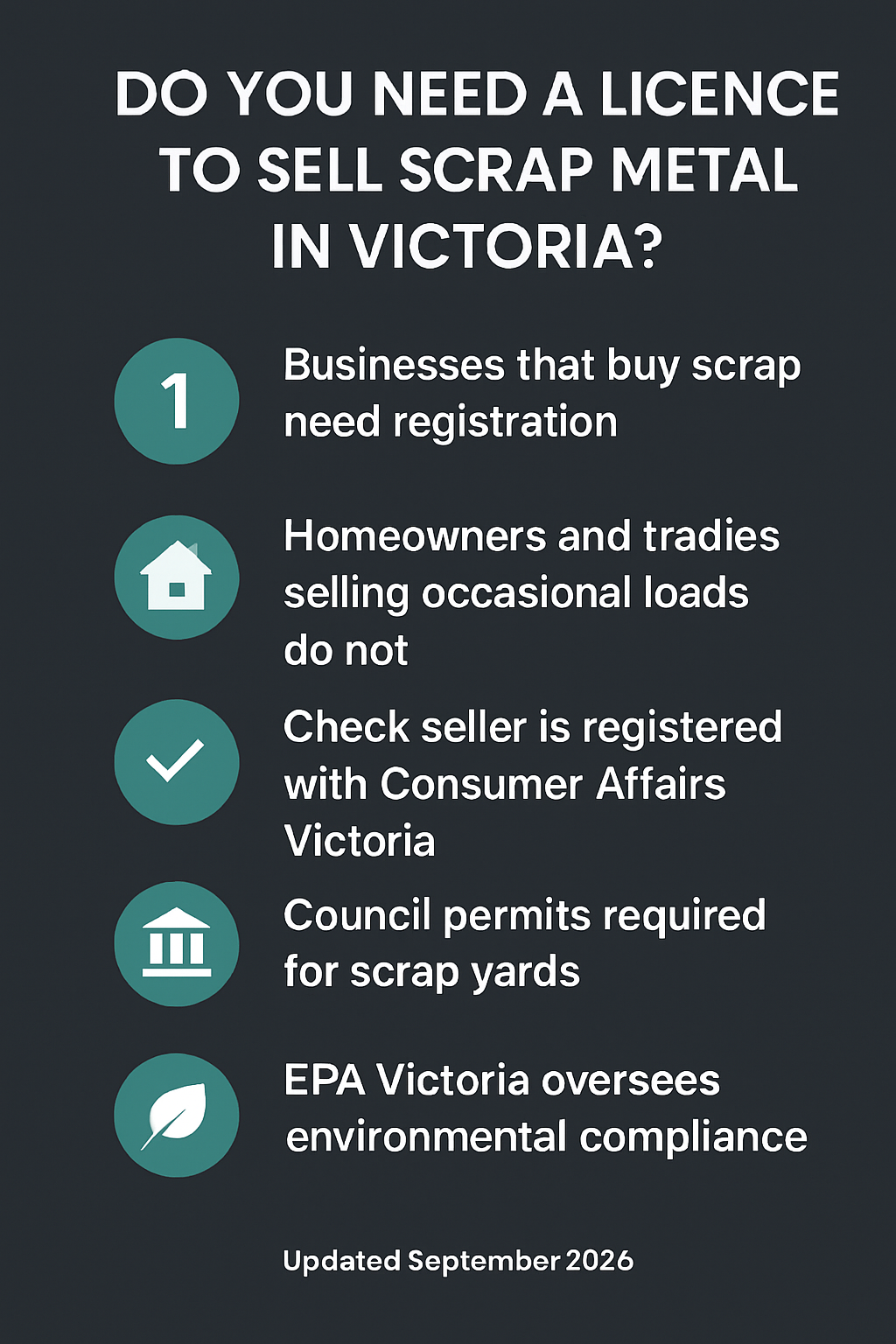
Under the Second-Hand Dealers and Pawnbrokers Act 1989 (Vic), businesses that buy and sell second-hand goods, including scrap metal, generally need to register with Consumer Affairs Victoria as second-hand dealers. That registration brings ongoing obligations around identity checks, record-keeping, and how transactions are conducted. If you’re running a scrap yard or metal recycling operation and buying material from the public, this is the registration category you’ll typically fall under.
We hold this registration ourselves, and we’re always happy to show a customer our credentials before we buy from them. You can also check the current requirements directly through Consumer Affairs Victoria’s guidance on second-hand dealer and pawnbroker registration, which sets out who needs to register and what’s expected once you are.
Local council permits and site zoning
Registration with Consumer Affairs Victoria is only part of the picture. A scrap yard or metal recycling facility also needs land that’s correctly zoned for that use. Most councils require a planning permit before a site can start receiving, storing or processing scrap metal. This covers noise, traffic movements, stormwater management and how material is stored on site.
If you’re setting up any kind of scrap collection or processing operation, check zoning and permit requirements with your local council. Do this well before you sign a lease or start accepting material.
Environmental obligations for scrap yards
Scrap metal handling isn’t just a consumer protection issue. It’s an environmental one too. Metal recycling sites often deal with fluids, coatings and contaminants that need careful management to avoid soil and waterway contamination. EPA Victoria oversees environmental licensing for facilities that store, process or dispose of scrap metal and related waste. Larger operations typically need a permit or licence, depending on the scale and type of material handled.
You can find current requirements through EPA Victoria’s information on environmental licensing for recycling and waste facilities. This is a genuine responsibility for any operator, not just a box to tick. It’s part of why properly run Melbourne recyclers put real weight behind how they manage collection and processing.
Who actually needs a licence to deal in scrap metal
This is where most of the confusion comes from. The registration obligation sits with the business buying the scrap, not necessarily with every person or business that sells it.
Businesses that buy and resell scrap metal
If you’re running a scrap yard, a metal recycling facility, or any business model where you purchase scrap metal from the public or trade customers and then on-sell it, you’re the one who needs to be registered as a second-hand dealer. That applies whether you’re running a small suburban operation or a larger facility handling industrial and commercial volumes.
Across Melbourne, established operators lead with registration and compliance. It’s what separates them from informal buyers with no oversight at all. If you’re a genuine dealer, being upfront about your registration status isn’t optional. It’s expected.
Occasional sellers and households
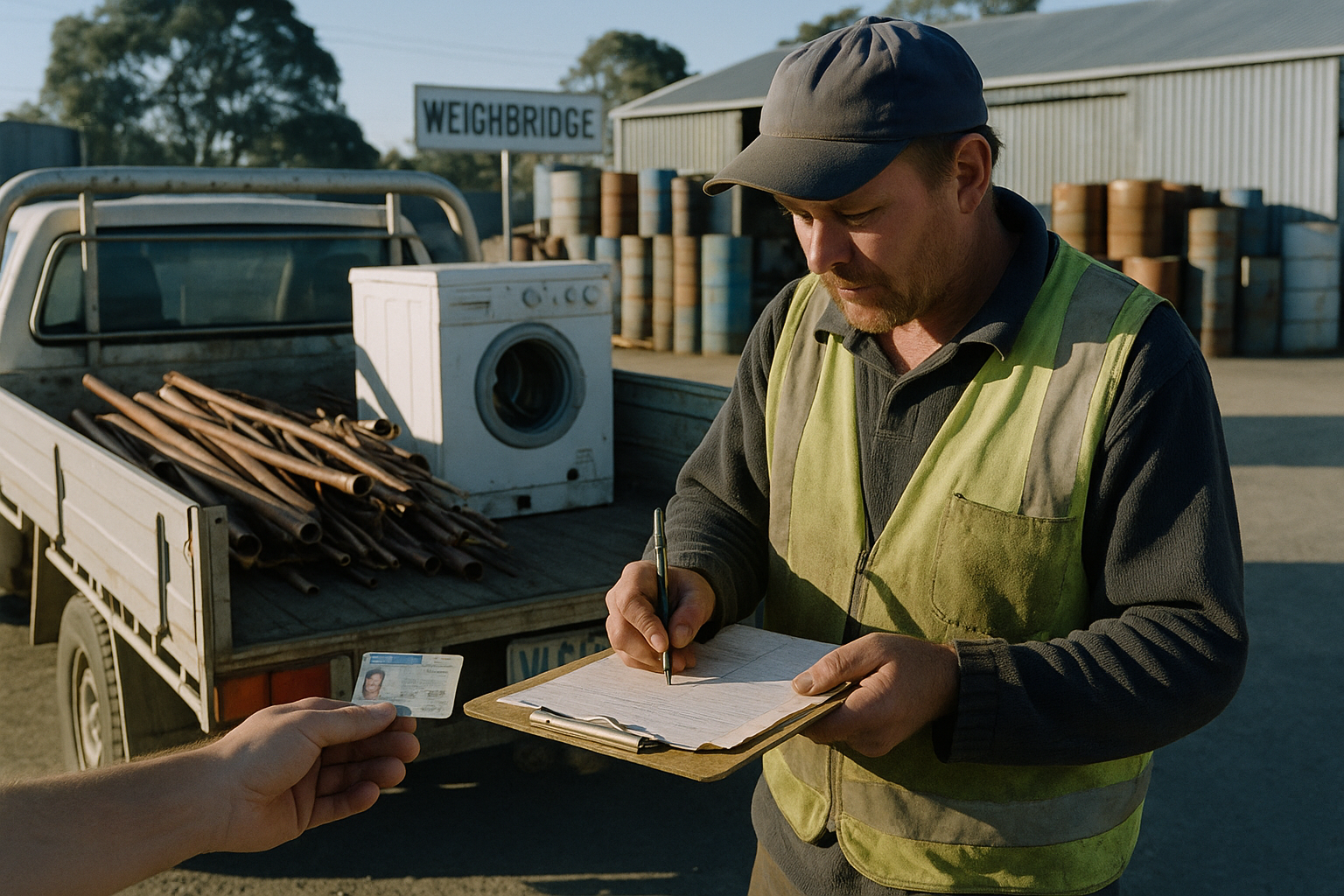
If you’re a homeowner clearing out an old fridge, a broken lawnmower, or leftover pipe from a plumbing job, you don’t need a licence to sell that material. The obligation isn’t on you as an occasional seller. It sits entirely with the business or yard buying the scrap from you.
That’s exactly why it matters who you sell to. A registered dealer will ask for ID and keep a record of the transaction. That’s not the dealer being difficult. It’s them meeting a legal obligation.
Tradies and businesses offloading metal waste
Tradies and small businesses that generate scrap metal as a by-product of their work generally don’t need their own dealer registration either. Think electricians clearing old cabling, plumbers disposing of copper offcuts, or builders clearing demolition steel. You’re selling material you’ve generated through your own work, not running a scrap buying and reselling operation.
It gets more complicated if a business starts regularly buying scrap from third parties with the intention of reselling it for profit. At that point you’ve crossed into dealer territory, and registration obligations likely apply. If you’re unsure which category your business falls into, the safest move is to check directly with Consumer Affairs Victoria rather than guess.
What a properly licensed dealer is required to do
A registered dealer carries specific obligations that exist to protect everyone involved in the transaction.
Identity checks and transaction records
Licensed dealers must verify the identity of sellers and keep records of transactions. That includes the type and quantity of material, the price paid, and who sold it. Our yard staff run through this with every customer, even for a small drop-off of a single hot water unit.
It might feel like a hassle if you’re just dropping off a trailer of scrap on a Saturday morning. But it’s a legal requirement, and a dealer who skips it is cutting a corner they shouldn’t be cutting.
Restrictions on cash payments
Cash transactions for scrap metal are restricted under Victorian law. Legitimate, registered dealers typically use traceable payment methods, particularly for larger amounts, rather than handing over cash on the spot. This rule reduces the incentive for metal theft and makes sure every transaction can be traced back if questions are raised.
If a “dealer” is offering you a wad of cash with no paperwork and no questions asked, treat that as a red flag rather than a bonus.
Reporting obligations for suspicious material
Registered dealers are also expected to stay alert to material that looks like it might be stolen. Freshly cut copper wiring still bearing insulation, manhole covers, road signage, or large quantities of building materials from someone with no obvious connection to a construction business are all examples. We’ve had to ask a few extra questions ourselves over the years when something didn’t add up, and once or twice we’ve simply declined to take material until the seller could explain where it came from. Operating legitimately means asking questions, and where necessary, reporting concerns rather than just processing the sale and moving on.
What happens if you deal in scrap metal without a licence
Operating outside the legal framework carries real consequences, both for the operator and for anyone who deals with them.
Penalties for unregistered dealing
Businesses that buy and sell scrap metal without the required second-hand dealer registration are operating in breach of Victorian law. That can bring penalties and enforcement action from regulators, and it puts the whole operation on shaky legal ground. An unregistered operator also has no real accountability if something goes wrong, whether that’s a payment dispute or a discovery that material passing through their yard was stolen.
Risks for sellers who use unlicensed operators
If you sell scrap metal to an unlicensed operator, you’re taking on risk too. There’s no guarantee of a fair weighing process. There’s no paper trail if you’re underpaid. There’s no real recourse if a dispute comes up. If it later turns out the operator was doing something illegal, you could find yourself trying to explain a transaction you have no documentation for.
It’s a fairly simple equation. Dealing with a registered operator protects you as much as it protects them.
How to check if a scrap metal dealer is legitimate
Before you hand over any material, particularly a larger load or something valuable like copper or brass, it pays to check who you’re actually dealing with.
Questions to ask before you sell
A few direct questions tell you a lot. Ask whether they’re a registered second-hand dealer and whether they can show evidence of that registration. Ask how they handle payment for larger transactions, since a legitimate operator won’t hesitate to explain their process. Ask whether they’ll need to see your ID, because if they don’t ask, that’s worth noting.
Signs a dealer is operating properly
A legitimate scrap metal dealer will generally have a fixed business address you can actually visit, not just a mobile number and a meeting point. They’ll have proper weighing equipment on site, transparent pricing based on current metal rates, and staff who can explain how the process works. They’ll ask for ID as a matter of course, not as an afterthought. If a dealer is cagey about any of this, treat it as a warning sign rather than an inconvenience.
Common real-world scenarios explained
Theory is one thing. Most people just want to know how this applies to their own situation.
Selling old appliances or a car from home
If you’re clearing out a garage and selling an old washing machine, a dead lawnmower, or an end-of-life car for scrap, you’re an occasional household seller. You don’t need a licence. What you do need is to sell to a properly registered dealer, who will ask for ID and record the transaction. That’s normal, not a hassle.
Clearing metal from a renovation or demolition site
Renovation and demolition jobs often generate significant volumes of steel, copper and aluminium. Last year one of our regular builder customers dropped off a load of over a tonne of demolition steel from a single-storey knockdown in Dandenong, split across three trailer trips over one week.
If you’re the builder or tradie clearing that material, you’re generating scrap as a by-product of your work rather than running a dealing operation, so no licence is needed on your end. Larger volumes are exactly where it’s worth confirming the receiving yard’s registration status and asking how they’ll handle payment, since bigger loads mean bigger transactions and more reason to have everything documented properly.
A small business generating regular scrap volumes
If your business regularly generates offcuts, packaging metal or retired equipment, and you sell that material to a scrap dealer on an ongoing basis, you’re still on the selling side. Registration obligations generally don’t apply to you.
It changes if your business starts actively buying scrap from other parties to resell it. That’s a different category entirely, and one where registration is likely required.
Practical tips for staying on the right side of the law
A few habits go a long way toward keeping every transaction clean and compliant.
Always ask a dealer directly whether they’re a registered second-hand dealer before doing business with them, particularly for larger or higher-value loads. Keep your own basic record of what you sold, when, and to whom, even as an occasional seller. It’s a small thing, but it protects you if any questions ever come up later.
Be wary of cash-only deals with no paperwork, especially for valuable non-ferrous metals like copper and brass. These are the materials most commonly targeted by unlicensed buyers, precisely because they move fast and hold strong value.
If you’re a business generating regular scrap volumes, it’s worth setting up an ongoing relationship with a single registered recycler rather than shopping loads around to whoever offers the best price on a given day. Consistent dealings with one properly registered operator make record-keeping easier for everyone, and usually mean better service over time.
If you’re ever unsure which category you fall into, whether as an occasional seller, a tradie, or a growing small business, contact Consumer Affairs Victoria directly rather than guessing. It’s a five-minute phone call that can save a lot of hassle later.
If you’re looking at ongoing scrap recycling for your household or business, our metal recycling services cover both residential and commercial drop-off, and we’re always happy to talk through what’s involved before you bring material in. Businesses generating regular volumes might also find our commercial and industrial scrap collection service a better fit than one-off drop-offs. If you’re prepping material for your first visit, our blog post on how to prepare scrap metal for recycling covers the practical side, and our piece on how scrap metal prices are calculated in Australia explains what affects the price you’re quoted.
Frequently asked questions
Do I need a licence to sell scrap metal from my own home in Victoria?
No. Occasional household sellers generally aren’t required to hold a dealer licence themselves. The registration obligation sits with the business or yard buying the scrap, not with you as an individual seller. The safest approach is always to sell to a properly registered dealer, which protects you as much as it protects them.
Is it legal to pay cash for scrap metal in Victoria?
Cash transactions for scrap metal are restricted under Victorian law, particularly for larger amounts. Legitimate, registered dealers typically use traceable payment methods for bigger transactions rather than handing over cash on the spot. This rule reduces theft and makes sure transactions can be traced if questions are ever raised.
What happens if I sell scrap metal to an unlicensed dealer?
If a dispute arises over price, weight or payment, you may have no real recourse, since there’s no formal registration or accountability behind the transaction. Unlicensed operators may also be operating illegally, which can expose them to penalties. It can also make it harder for you to prove where material came from if questions are raised later, particularly for higher-value non-ferrous metals.
Do tradies and small businesses need a scrap metal licence?
Generally, no. Businesses generating scrap as a by-product of their work, such as offcuts or retired equipment, typically sell to a licensed dealer rather than needing their own registration. Businesses that regularly buy scrap from others to resell for profit are treated differently, and likely need registration as a second-hand dealer. If you’re unsure which category applies to you, check directly with Consumer Affairs Victoria for guidance specific to your situation.
How can I verify a scrap metal dealer is legitimate before selling to them?
Ask to see evidence of their registration or licence as a second-hand dealer. Check whether they ask for identification as part of the transaction, since that’s a strong sign of proper compliance. Look for a fixed business address, transparent weighing processes, and clear, upfront pricing rather than vague or shifting numbers.
Getting it right, every time
Scrap metal dealing in Victoria is regulated for good reason. Understanding where you sit in that framework makes every transaction