
That old car sitting in your driveway is not just an eyesore. It is actively costing you money, eating up space, and in some cases creating legal headaches that are entirely avoidable. If you have a dead, damaged, written-off, or simply unwanted vehicle taking up room, junk car removal in Melbourne is one of the fastest ways to turn a real liability into cash, often on the same day you call.
Here is the catch, though. The Melbourne market is packed with operators, and they are not all playing the same game. Some will quote you a solid number over the phone and then arrive with something considerably lower. Others bury towing fees in the fine print. A few will take your car and leave you with incomplete paperwork, which can mean a legal mess that follows you long after the vehicle is gone.
We have processed thousands of end-of-life vehicles across Melbourne’s northern and western suburbs, from beat-up Commodores in Broadmeadows to flood-damaged utes in Sunshine. The questions we hear most often are the same: what is my car actually worth, who can I trust, and what do I need to sort out before the truck shows up? This guide answers all of that, covering how the process works, what your junk car is realistically worth, how to protect yourself from dodgy operators, and what to prepare beforehand. Whether you have a rusted-out sedan, a flood-damaged ute, or a 4WD that has not turned over in two years, read this first.
Why That Dead Car Is Costing You More Than You Realise
Most people put off dealing with an old or dead vehicle because it feels like effort. The problem is that the longer it sits, the more it costs, and usually in ways that are easy to overlook.
The Hidden Costs of Holding onto a Junk Vehicle
A vehicle that is no longer roadworthy still carries ongoing expenses. If registration has not been cancelled, you may still be paying for it. Insuring a car you cannot drive is money straight in the bin. If the vehicle is leaking fluids onto your driveway or garage floor, such as engine oil, coolant, or transmission fluid, you are looking at potential environmental liability on top of a clean-up cost.
Batteries in neglected vehicles degrade and can leak acid. Tyres go flat and eventually rot. Fuel tanks in cars that have sat unused for extended periods can develop dangerous pressure build-up during Melbourne’s summer heat. A dead car that looks harmless tends to quietly create real problems over time.
Then there is the opportunity cost. Your driveway, garage, or yard has real value, and letting a junk car rust in place gives that up for nothing.
Council Regulations and Abandoned Vehicle Rules in Victoria
Victorian local councils take junk and abandoned vehicles seriously. Under state law, councils have authority to issue notices requiring removal of unregistered vehicles from private property, particularly when they are visible from a public road. Depending on your council, ignoring those notices can result in fines.
Unregistered vehicles parked on public streets are also subject to council ranger removal. If your car gets towed by council, you will pay storage fees to recover it on top of whatever fines apply. Getting rid of it on your own terms, and actually getting paid in the process, is the smarter move by a considerable margin.
What Exactly Is a Junk Car? (And Yes, Yours Probably Qualifies)
The term gets used loosely, but in Melbourne’s scrap and removal market it covers a much wider range of vehicles than most people expect.
Common Types of Vehicles Accepted for Junk Removal
If your vehicle fits any of the descriptions below, it qualifies for junk car removal:
- Non-running vehicles, cars that will not start, have seized engines, or have failed mechanically
- Written-off vehicles, insurance write-offs, both statutory and repairable, that are no longer economical to fix
- Accident-damaged vehicles, crash damage, rolled vehicles, or cars with structural damage
- Flood-damaged vehicles, water-damaged cars from storms or flooding events, a genuine issue in parts of Melbourne
- Old or high-kilometre vehicles, cars that have simply reached the end of their useful life
- Rusted vehicles, body or chassis corrosion that makes repair unviable
- Unwanted vehicles, cars sitting unused for months or years for any reason
Reputable Melbourne operators also accept utes, vans, 4WDs, trucks, and commercial vehicles. The broader the range of vehicle types an operator accepts, the more flexibility they generally offer on condition and pricing.
Does Vehicle Condition Really Matter for Scrap Value?
Condition affects value, yes. It does not disqualify a vehicle from being accepted. Even a heavily damaged or completely non-running car retains scrap metal value because steel, aluminium, copper wiring, and catalytic converters hold commodity value regardless of whether the car can move under its own power.
Do not assume your car is worthless because it will not start or looks terrible. In most cases, it is worth more than you think.
How Junk Car Removal in Melbourne Actually Works
The process is simpler than most people expect. Here is a clear breakdown from start to finish.
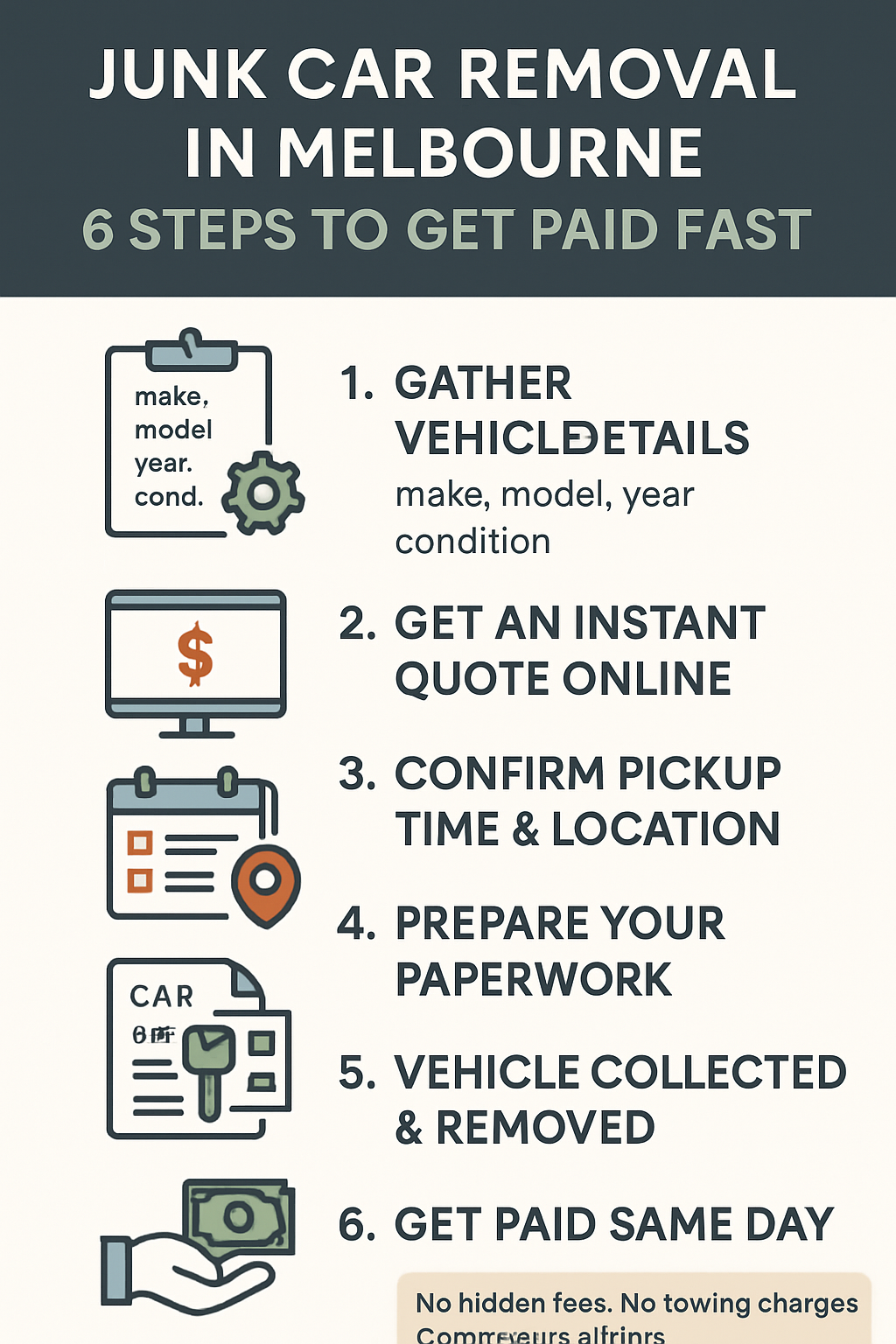
Step 1: Get a Quote, What Information You Need Ready
Before you call or submit an online form, have the following ready:
- Make, model, and year of the vehicle
- Body type (sedan, SUV, ute, van, truck) or approximate weight
- Current condition, whether it runs, and any notable damage or faults
- Your suburb and postcode
- Whether you have the registration papers and title
The more accurate the information you provide, the more accurate the quote you will receive. Operators use these details to estimate metal content and salvageable parts, which is what drives the offer.
Step 2: Confirm the Pickup Time and Paperwork
Once you have a quote you are happy with, confirm a pickup time. Most professional operators in Melbourne can arrange same-day or next-day collection. Before the truck rolls out, get the quote confirmed in writing, via email or text. This is your protection if the operator tries to revise the number on arrival. Also confirm explicitly, upfront, that pickup and towing are included at no additional cost.
Step 3: Vehicle Collection and On-the-Spot Payment
On collection day, the removal team arrives, inspects the vehicle to confirm it matches what was described, and completes the paperwork. Payment happens on the spot, usually cash or bank transfer depending on the operator. The vehicle is loaded onto the tow truck and removed from your property. From arrival to departure, the whole process typically takes under an hour.
Step 4: What Happens to Your Car After Removal
Your vehicle goes to a licensed recycling facility. Fluids are drained and disposed of safely. Reusable parts are removed and catalogued for resale. The remaining shell and metal components go through a shredder, with materials sorted by metal type for smelting and reprocessing. Done properly, nothing useful goes to waste and no hazardous materials end up in landfill or waterways.
How Much Is Your Junk Car Actually Worth in Melbourne?
This is the question everyone wants answered first, and the honest answer is that it depends on several factors.
Key Factors That Affect Your Scrap Car’s Value
- Vehicle weight, heavier vehicles contain more metal. A large 4WD or commercial van will fetch more than a small hatchback simply because there is more raw material in it.
- Metal composition, vehicles with higher aluminium content, common in newer models and some European makes, may attract better offers than older all-steel vehicles.
- Catalytic converter condition, catalytic converters contain precious metals and add meaningful value if they are intact.
- Reusable parts, engines, gearboxes, doors, and panels in reasonable condition can increase an offer significantly. Operators who carry out proper salvage assessments tend to pay more as a result.
- Current scrap metal prices, commodity prices for steel and aluminium fluctuate globally, and local scrap rates follow. Understanding what affects scrap metal prices can help you time your sale more effectively.
- Vehicle age and make, some makes and models have parts in higher demand in the second-hand market, which can push offers higher.
What You Can Realistically Expect to Receive
Scrap steel prices in Australia have traded between roughly $150 and $250 per tonne through mid-2026, with aluminium commanding considerably more per kilogram due to its lighter weight and higher demand. A typical passenger car weighs between 1,000 and 1,500 kilograms, so the base metal value alone is meaningful even before part salvage is factored in. Heavier vehicles such as utes, vans, and 4WDs generally attract stronger offers due to greater metal content.
To put that in practical terms, a 2005 Ford Falcon sedan in non-running condition but with an intact catalytic converter can realistically return a meaningfully higher offer than one that has had its catalytic converter removed, which is worth checking before you call. Getting two or three quotes before committing gives you a realistic comparison and some negotiating room.
Why Quotes Vary So Widely Between Operators
Not all operators use the same pricing model. Some focus purely on weight-based scrap metal value, while others factor in part salvage potential and can offer more for vehicles with usable components. Location also plays a role. If you are in an outer suburb or a harder-to-access area, some operators may factor towing costs into their offer, which is exactly why confirming free pickup upfront matters so much.
How to Avoid Getting Ripped Off: Red Flags to Watch For
Melbourne’s junk car removal market has plenty of legitimate operators. It also has its share who rely on customers not knowing what to expect. Here is what to watch for.
Lowball Offers After the Truck Arrives
This is the most common tactic in the industry. An operator quotes a strong number over the phone to get your commitment, then when the truck arrives the driver suddenly “inspects” the vehicle and revises the offer downward, sometimes dramatically. By that point, you feel committed and the pressure builds to just accept it.
How to protect yourself: get the quote confirmed in writing before agreeing to anything. If the operator refuses to put a number in writing, that tells you everything you need to know.
Hidden Fees for Towing or Administration
Free pickup is standard practice across Melbourne’s junk car removal market. Some operators, however, quietly add towing or administration fees at payment time, reducing your actual payout. Ask explicitly, before booking, whether towing and all associated costs are included at no charge, and get that confirmed in your written quote.
Operators Who Will Not Put a Quote in Writing
A legitimate operator has no reason to avoid putting a quote in writing. If someone is only comfortable dealing verbally and cannot send you a number via text or email, treat it as a serious warning sign and keep looking.
No Licence or Proper Disposal Documentation
In Victoria, end-of-life vehicles must be disposed of responsibly under EPA Victoria’s waste and resource recovery guidelines. A legitimate scrap metal recycler will be licensed and will provide transfer of ownership documentation. Without that paperwork, you may retain legal liability for the vehicle after it leaves your property. Always request documentation and keep a copy for your own records.
What to Do Before the Removal Team Arrives
A bit of preparation makes the whole process smoother and protects you legally.
Paperwork and Transfer of Ownership in Victoria
You will need your vehicle registration certificate and proof of identity. In Victoria, ownership of a vehicle being sold or scrapped must be transferred through VicRoads. The removal operator should provide a receipt or transfer documentation, so keep this as proof that the vehicle is no longer your responsibility. Do not skip this step.
Removing Personal Belongings and Valuables
It sounds obvious, but it is surprising how often people leave things behind. Check the glove box, boot, under the seats, door pockets, and the spare tyre compartment thoroughly. Remove your e-tag and cancel or transfer any toll accounts linked to the vehicle. Registration papers, parking passes, charging cables, tools, and occasionally cash all get left behind in vehicles being scrapped.
Draining Fluids and Removing Reusable Parts (If Applicable)
If you have mechanical knowledge and there is a part worth keeping or selling separately, such as a set of good tyres, a working battery, or aftermarket accessories, remove them before the truck arrives. Once the vehicle is collected, you lose access to those parts. Selling quality components separately can sometimes return more than leaving everything for the recycler to assess.
Cancelling Your Registration and Insurance
Cancel your vehicle registration with VicRoads at or before the time of sale. This stops any ongoing registration costs and protects you from future claims tied to the vehicle. Notify your insurer at the same time to cancel or transfer the policy. If there is any unused registration period remaining, you may be entitled to a partial refund.
Why Responsible Metal Recycling Matters for Melbourne
Junk car removal is not just about clearing space and pocketing some cash. Done properly, it carries a real environmental benefit that is worth understanding.
The Environmental Impact of Proper Vehicle Disposal
An end-of-life vehicle contains a range of hazardous materials: engine oil, coolant, brake fluid, transmission fluid, battery acid, refrigerants, and fuel. If a vehicle is abandoned or dumped, these substances leach into soil and groundwater over time, causing long-term environmental damage. EPA Victoria regulates the disposal of these materials under its industrial waste framework, and responsible recyclers comply with these requirements as a baseline, not as an afterthought.
Proper disposal also diverts enormous quantities of material from landfill. Steel and aluminium recycling uses a fraction of the energy required to produce virgin metal, which is a genuine environmental saving at scale. The Waste Management and Resource Recovery Association of Australia (WMRR) recognises vehicle recycling as one of the higher-yield resource recovery streams in the country, given the volume of recoverable metal in each vehicle.
How Scrap Metal Recyclers Process Old Vehicles
Understanding how scrap metal recycling works gives you a clearer picture of what happens after your car leaves the driveway. At a licensed facility, the process runs roughly like this:
- Fluid removal, all hazardous fluids are drained, collected, and disposed of or recycled through approved channels
- Part salvage, usable components are removed and catalogued for resale in the second-hand parts market
- Battery and tyre removal, batteries go through specialist recycling; tyres are processed separately
- Shredding, the vehicle shell is crushed and shredded
- Metal sorting, ferrous metals (steel and iron) and non-ferrous metals (aluminium and copper) are separated using magnets and eddy current separators
- Smelting, sorted metals are sent to mills for reprocessing into new raw material
The result is a vehicle effectively returned to its raw components, most of which re-enter the supply chain as recycled material rather than going to landfill.
Why Choose Johny Metal Recycling for Junk Car Removal in Melbourne
At Johny Metal Recycling, we handle junk car removal across Melbourne with a straightforward process built on no pressure, no hidden fees, and no last-minute quote revisions when the truck pulls up. Our team covers Melbourne’s northern, western, and south-eastern suburbs, and we have handled everything from abandoned 4WDs to hail-damaged fleet vehicles across the greater metro area.
A recent job in Sunshine is a good example of how we work. A customer contacted us about a 2008 Toyota Hilux that had been sitting unregistered in their yard for nearly three years after a rear-end collision. The vehicle was non-running and had significant panel damage across the rear, but the engine block and catalytic converter were both intact. We assessed all of that in the quote, collected it the following morning, completed all transfer paperwork on site, and paid out on the spot. No revised offer on arrival, no towing fee, no administration charge.
That is the outcome we aim for every time.
Free Pickup, Fast Turnaround, and Fair Cash Offers
Free pickup is standard here. You will not find a towing surcharge or administration fee buried in the paperwork at payment time. Quotes are confirmed before we arrive, and payment is made on the spot at collection. For most Melbourne locations, we can arrange same-day or next-day pickup.
Our pricing is based on the real scrap and salvage value of your vehicle, assessed honestly from the details you provide. We are straightforward about how we value vehicles and what drives the offer we make.
All Vehicle Types Accepted: Cars, Utes, Vans, 4WDs, and More
We accept passenger cars, utes, vans, 4WDs, trucks, and commercial vehicles in any condition, whether running or not, damaged, old, or simply unwanted. If you are not sure whether your vehicle qualifies, get in touch directly for a fast, no-obligation quote.
Our junk car removal service in Melbourne is built around making the process as simple and transparent as possible from first contact through to final pickup.
Stop Letting a Dead Car Take Up Space, Get Paid to Remove It
A junk car is not just an inconvenience sitting in your driveway. It is a financial drain, a potential legal issue, and a missed opportunity to put real cash in your pocket. Junk car removal in Melbourne means you can turn that dead vehicle into money, usually within 24 hours, without spending a cent on towing.
The approach is straightforward: know what your vehicle is worth, get your quote in writing, confirm free pickup upfront, and have your paperwork sorted before the truck arrives. Do those things and the process is genuinely hassle-free.
If you have a dead, damaged, or unwanted vehicle anywhere in Melbourne, get in touch with Johny Metal Recycling today. Visit jmrecycling.com.au or contact the team directly for a no-obligation quote. We will give you a straight answer on what your vehicle is worth and have it off your hands fast.
Frequently Asked Questions
How much can I get for a junk car in Melbourne?
Cash offers vary depending on the vehicle’s make, model, age, weight, and condition. With scrap steel trading between roughly $150 and $250 per tonne in the Australian market through mid-2026, even a non-running or heavily damaged vehicle retains real metal value. Heavier vehicles like utes, vans, and 4WDs generally attract stronger offers due to greater metal content. Getting two or three quotes before committing is always the smart approach.
Does the car need to be running for junk car removal in Melbourne?
No. Reputable operators across Melbourne accept vehicles in any condition, including non-running, written-off, flood-damaged, and accident-damaged vehicles. The scrap metal value of a vehicle does not depend on whether it can start or drive. Confirm this upfront when requesting a quote and make sure the operator is not quietly pricing in a condition requirement that was never part of the original agreement.
Is junk car removal in Melbourne really free?
Many operators offer free towing or pickup as part of the standard service, and this is competitive practice across the Melbourne market. Some operators, however, attempt to charge hidden fees for administration or towing after the vehicle has already been collected, effectively reducing your net payout. Always confirm in writing that pickup is included at no cost before agreeing to proceed.
What paperwork do I need to scrap a car in Victoria?
You will need your vehicle registration certificate and proof of identity. In Victoria, you must transfer or cancel registration with VicRoads at or before the time of sale. A receipt or transfer of ownership document from the removal operator is important to keep, as it protects you from any future liability tied to the vehicle. Check the VicRoads website for the current process for transferring vehicle ownership when scrapping.
What types of vehicles does Johny Metal Recycling accept?
We accept passenger cars, utes, vans, 4WDs, trucks, and commercial vehicles in any condition, whether running or not, damaged, old, or simply unwanted. Contact the team at jmrecycling.com.au for a fast quote on your specific vehicle.
How quickly can I get my junk car removed in Melbourne?
Most professional operators in Melbourne offer same-day or next-day collection. The speed of pickup depends on your location, vehicle type, and availability. Having your paperwork ready and confirming your address and vehicle details upfront speeds the process up considerably.
What happens to my junk car after it is removed?
At a licensed facility, the vehicle is dismantled, hazardous fluids are drained and disposed of through EPA-compliant channels, and usable parts are salvaged for resale. The remaining metal goes through a shredder and is sorted and sent for smelting and reprocessing into new raw material. Responsible recycling ensures toxic materials like engine oil, coolant, and battery acid stay out of landfill and waterways.
Published by Johny Metal Recycling | July 2026
