
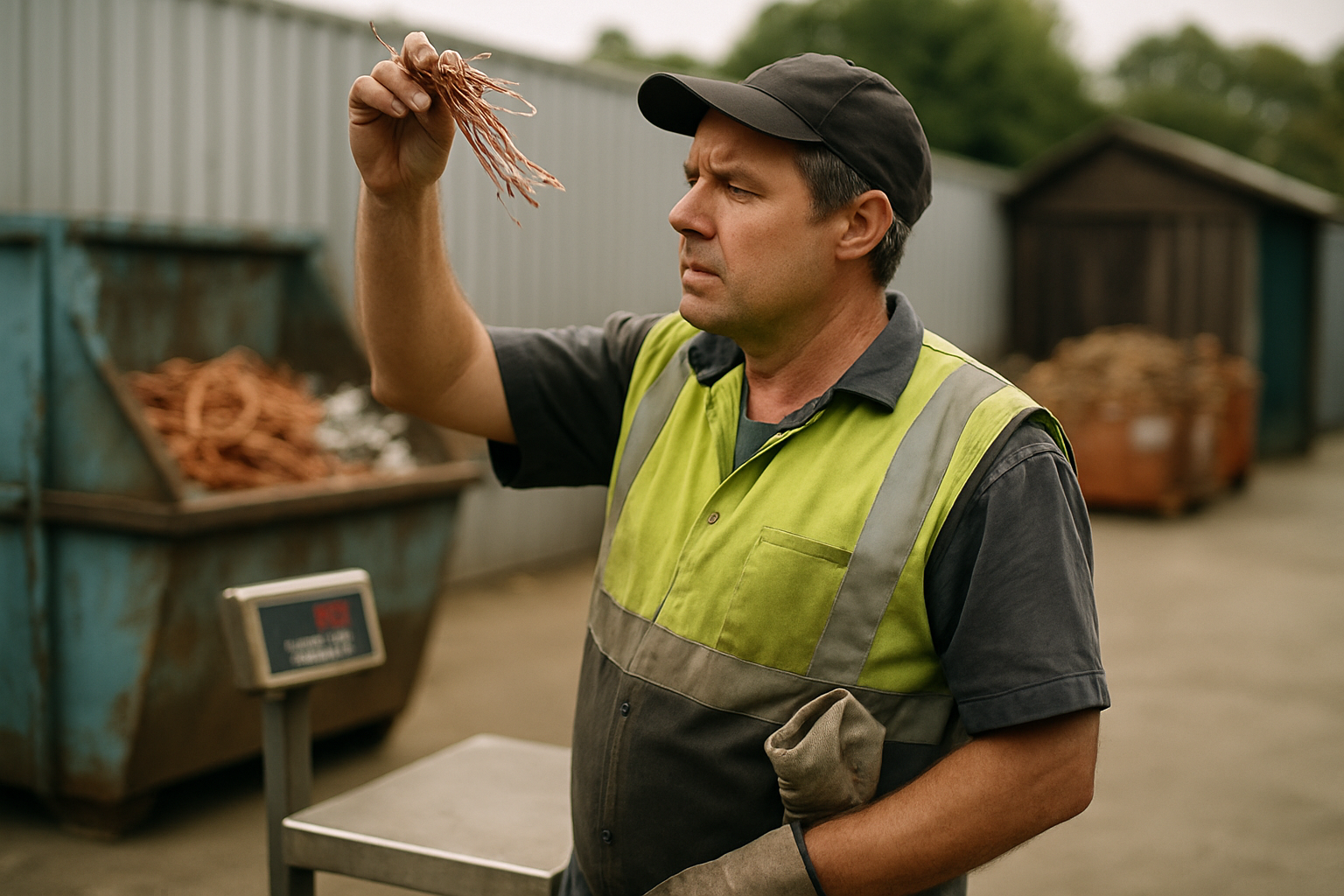
If you’ve ever called a Melbourne scrap yard, got a price over the phone, then turned up to find the rate had changed, you’re not alone. It’s one of the most common frustrations for people selling scrap metal, and the explanation is straightforward once you understand how pricing actually works. Scrap metal prices aren’t arbitrary. They’re driven by global markets, local demand, metal type, and the condition your material arrives in. Once you understand how those factors work together, you gain a real advantage, and in some cases that knowledge alone can mean hundreds of dollars more from the exact same load.
At Johny Metal Recycling, our operations team has been buying and processing scrap metal at our Melbourne yard for over 15 years, handling thousands of tonnes of material annually across copper, aluminium, brass, steel, and more. We see firsthand how much sellers leave on the table simply because they don’t know what drives the price they receive. This article breaks down how Melbourne scrap yard prices are set, what causes them to shift, and the practical steps you can take to consistently get a better return.
Reviewed by the Johny Metal Recycling Operations Team, September 2026. Johny Metal Recycling operates in accordance with MRI Australia (Materials Recycling Industry of Australia) industry standards for pricing transparency and responsible material handling. All prices should be confirmed with your yard on the day of drop-off, as rates move daily.
Why Scrap Metal Prices Are Never Fixed
There’s a reason scrap yards don’t publish a price list that stays the same week to week. The value of raw metal is determined by forces well outside any individual yard’s control.
Global Commodity Markets Drive Local Prices
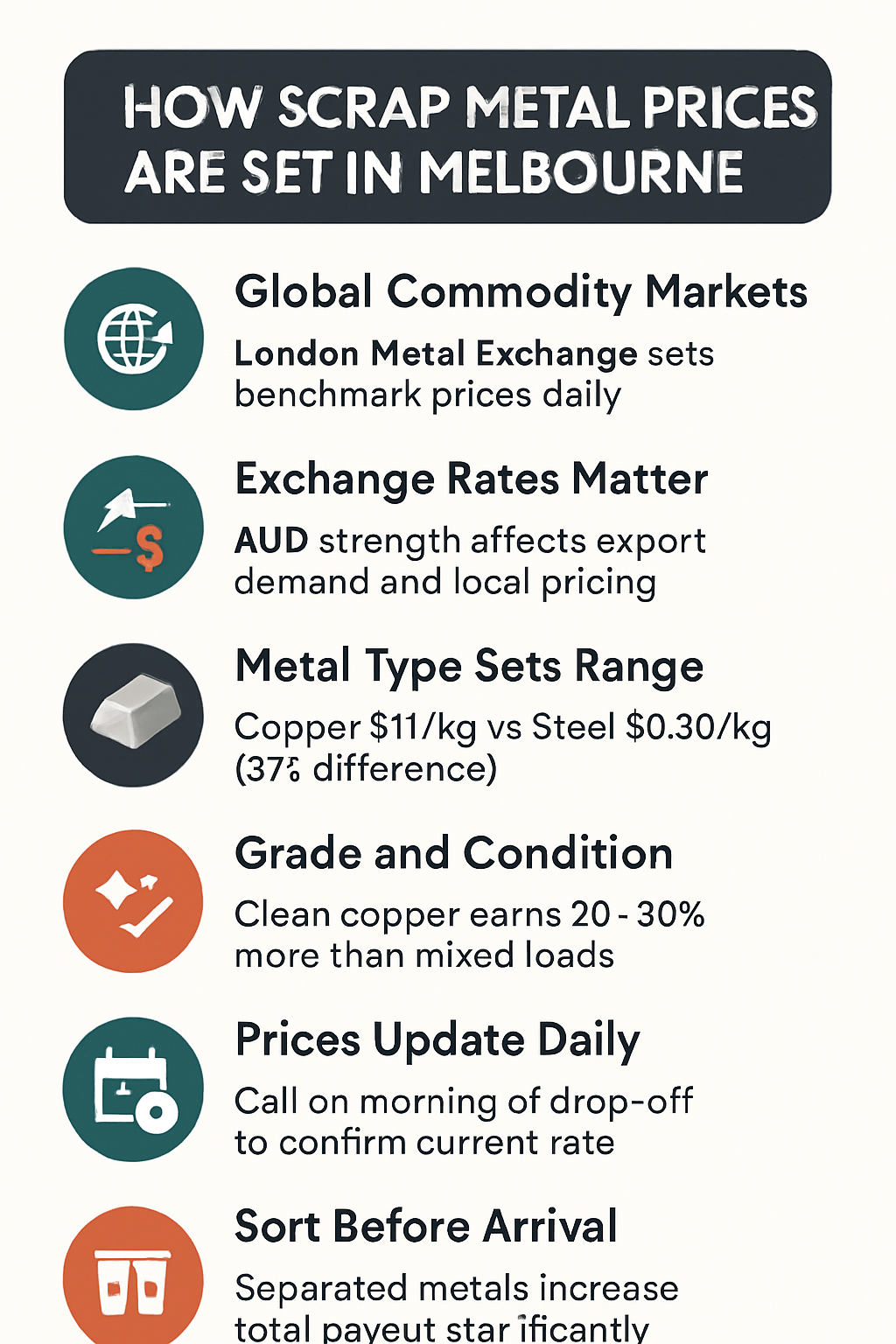
Every major metal, including copper, aluminium, brass, and steel, is traded as a commodity on global exchanges. The most influential is the London Metal Exchange (LME), which sets benchmark prices that flow through to local scrap buyers all over the world, including here in Melbourne. When copper futures move on the LME, Melbourne scrap yards adjust their buying rates to reflect the new market reality. There’s no buffer that shields local pricing from those global shifts, which is why a rate you received last week may genuinely no longer apply.
Exchange Rates and Export Demand
Australia’s scrap metal industry is heavily tied to export markets, particularly across Asia. When the Australian dollar weakens against the US dollar, Australian scrap becomes cheaper for overseas buyers, which tends to increase demand and push local prices up. When the dollar strengthens, the reverse often happens. Demand from Chinese steel mills and Asian copper smelters has a direct influence on what Melbourne yards are willing to pay on any given day. The Australian Bureau of Statistics tracks exchange rate movements that affect exactly this kind of commodity export competitiveness, and those movements can shift the local rate noticeably within a single week.
It’s also worth knowing that MRI Australia monitors how these trade flows affect domestic scrap values, particularly for ferrous and non-ferrous metals sold into Asian processing markets. Yards that hold MRI Australia membership are generally subject to industry standards around pricing transparency and responsible material handling.
How Daily Movement Affects Your Quote
Melbourne scrap yards can, and often do, update their prices every 24 hours. A quote given on Monday may genuinely not hold by Wednesday. This isn’t a bait-and-switch. It reflects real market movement. If you’re planning a significant drop-off, calling ahead on the morning of your trip is the single easiest way to avoid a surprise at the weigh-in.
The Biggest Factor You Can Actually Control: Metal Type and Grade
You can’t control global commodity markets, but you absolutely control what you bring in and how you present it. That starts with understanding the wide price spread between different metal types.
The Price Gap Between Common Metals Is Enormous
The range of scrap metal prices per kilogram in Melbourne is wider than most people realise. Steel, classified in the industry as HMS (heavy melting steel, meaning structural steel and heavy plate), sits at roughly $0.30 per kg, while clean copper can reach $11 per kg or higher for premium grades. That’s approximately a 37-times difference between the lowest and highest common metals, at the same yard, on the same day. This is why identifying your metals before you arrive matters as much as it does.
Why Copper Earns So Much More Than Steel
Copper’s value comes from its conductivity, corrosion resistance, and the significant energy cost of producing it from raw ore. These properties make it essential for electrical infrastructure, plumbing, and manufacturing, which sustains consistent, high global demand. To put it in practical terms: a 100 kg load of steel earns around $30 at current Melbourne rates. The same weight in clean copper earns approximately $1,100. That’s not a minor variation. It’s the difference between a trip that barely covers fuel and one that genuinely pays.
Aluminium, Brass, and Stainless Steel: Where They Sit
Between steel and copper sit several metals worth understanding before you load up the ute. Aluminium typically ranges from $0.90 to $2.80 per kg depending on grade and form. Brass generally falls between $4.20 and $6.50 per kg. Stainless steel usually sits around $1.00 to $2.20 per kg depending on grade. Each of these has real value, but only if they’re sorted, separated, and presented correctly when you arrive.
How Metal Grade and Condition Change Your Payout
Metal type gets you into the right ballpark. Grade and condition determine exactly where within that range you land, and that gap can be substantial.
What ‘Grade’ Actually Means at a Melbourne Scrap Yard
Grade refers to the purity, cleanliness, and composition of your metal. Yards classify scrap into sub-categories for each metal type, and each sub-category carries a different rate. The cleaner and more uniform your material, the higher the grade it qualifies for, and the more you receive per kilogram. This reflects the real cost of processing. A yard that has to strip, sort, or smelt out contaminants will pay you less because that work costs them time and money.
Copper: The Cleanliness Factor That Can Shift Your Rate by $9/kg
Copper is where grade makes the most dramatic financial difference. Bright, shiny stripped copper wire, the cleanest and highest-grade form, can sit at $16.20 to $18.00 per kg at the top end of current Melbourne pricing. Mixed or insulated copper, or burnt and tinned copper, fetches considerably less. The spread within copper alone can reach $9 per kg.
Stripping insulation from wire before you arrive, removing fittings from pipe, and ensuring your copper is free from paint and solder moves it into a higher-paying bracket. For a 50 kg load, that preparation difference could be worth $450 for the exact same metal presented differently. If you regularly deal with copper, understanding copper recycling in Melbourne and what preparation we expect makes a real difference to your payout.
Aluminium Sub-Types: Why Cuttings Beat Cast
Aluminium pricing in Melbourne is a clear example of how sub-type classification plays out in practice. Aluminium cuttings return $1.30 to $1.60 per kg, while aluminium cast fetches $1.00 to $1.10 per kg. Alternator and starter motors, which contain aluminium among other materials, return only $0.60 to $0.90 per kg. The reason motors perform poorly isn’t that yards don’t want them. It’s that a whole motor contains copper windings, steel casings, and aluminium housing all mixed together, and yards price the labour required to separate those components into what they pay you.
What Mixed or Contaminated Loads Do to Your Price
When materials are mixed, yards typically assess the load at the rate of the lowest-value metal present, or apply a blended rate that’s lower than what any individual component would fetch on its own. A load of copper pipe with brass fittings still attached, or aluminium framing mixed with steel bolts, will return less than if those components had been separated. The rule of thumb is simple: one metal type per container.
Practical Steps to Get a Better Price Before You Arrive
None of the above is fixed. Here’s what you can genuinely do to improve your return at the yard.
Strip, Separate, and Sort Before You Go
This is the highest-return activity for most sellers. Stripping insulation from copper wire, removing steel fittings from copper pipe, and sorting aluminium types into separate containers takes time, but it almost always pays. Our guide on how to sort and prepare your scrap metal before drop-off covers the process step by step if you want a detailed walkthrough.
Start with a simple system: one container per metal type. Label them if you have multiple similar metals. When you arrive at the yard, your load is already pre-sorted and can be graded accurately without delay.
Call Ahead on the Day, Not Earlier in the Week
Don’t rely on a price from a few days ago. Call the yard on the morning you plan to make the trip, describe your metals and approximate weight, and confirm the current rate. This gives you a realistic expectation and the chance to ask whether there’s anything you should do differently before arriving. It takes two minutes and regularly saves sellers from an unwelcome surprise at the weigh-in.
Know Your Approximate Weight Before You Leave
Using a bathroom scale or a basic hanging scale for smaller loads gives you a rough sense of what your material is worth before you head off. If you know you have 30 kg of copper wire and the current rate is $15 per kg, you’re expecting roughly $450. If the yard quotes you significantly less, you’ll know to ask why. Knowing your approximate weight also helps you decide whether it’s worth making the trip that day, or whether accumulating more material first would make better financial sense.
Don’t Overlook Small Volumes of High-Value Metals
Copper, brass, and stainless steel are worth bringing in even in modest quantities. A few kilograms of copper fittings or brass valves collected over a few weeks can add up to a meaningful payout. Knowing which metals are worth collecting and recycling helps you make smarter decisions about what to keep separate versus what to fold into a general load.
Metals That Sellers Often Miss or Undervalue
Some metals consistently get lumped into mixed loads, or skipped entirely, because sellers don’t realise their value. Here are three worth paying closer attention to.
Stainless Steel 316 and Lead
Stainless steel 316 currently returns around $2.20 per kg in Melbourne, meaningfully higher than standard steel at $0.30 per kg. If you work in industries that regularly use 316-grade fittings, pipe, or equipment, it’s worth separating and identifying this material clearly when you arrive. Lead, when clean, returns approximately $1.80 per kg. It’s dense, so even modest volumes translate to meaningful weight and a worthwhile payout. Both metals are frequently mixed in with lower-value loads and sold at a fraction of what they could return.
Copper Windings Inside Motors
If you regularly deal with electric motors, the copper windings inside them represent real value that’s often left on the table. Whole motors return $0.60 to $0.90 per kg. The copper windings inside, once separated, qualify for copper rates. The steel casing and aluminium housing can also be separated and sold at their respective rates. For anyone dealing with a reasonable volume of motors, dismantling them beforehand can meaningfully increase the total payout.
Brass Fittings Separated From Mixed Loads
Brass is commonly found on plumbing fittings, valves, taps, and industrial equipment. At $4.20 to $6.50 per kg, it sits well above aluminium and significantly above steel. The problem is that it’s often left attached to other materials and sold as part of a mixed load at a lower blended rate. Taking 20 minutes to sort brass fittings into their own container before you arrive is almost always worth your time.
What to Expect When You Arrive at the Yard
Understanding the process at a Melbourne scrap yard helps you arrive prepared and avoids misunderstandings at the weigh-in.
How Yards Assess Your Metal on the Spot
When you pull in, yard staff will inspect your load visually and physically. They’re assessing metal type, grade, cleanliness, and whether there are attached materials or contaminants. This determines which grade bracket your metal falls into. If you’ve sorted and prepared well, the process is faster and typically results in a more accurate, and higher, price.
One example from our own yard: a plumber who brought in a 40 kg mixed load of copper pipe and brass fittings received a blended rate on his first visit. The next time he came in, he’d separated the two materials into different containers. The copper graded as No.1 pipe and the brass was assessed cleanly in its own right. His payout on a comparable load increased by around $180 for the same weight. That’s a direct result of presentation, not more material.
Transparency About What You’re Bringing In Helps
If you’re unsure what grade your metal is, say so. Yard staff assess scrap every day and can often tell you on the spot what you have and what it’s worth. Describing your load accurately when you call ahead also means the quote you receive is more likely to match the outcome at the weigh-in. Experienced staff identify material grades quickly, so attempting to pass off a lower-grade material as something higher generally backfires.
The Difference Between a Phone Quote and a Weigh-In Price
A verbal quote over the phone is an estimate based on what you’ve described and the current market rate. The weigh-in price is what you actually receive, determined by the physical assessment of your material on arrival. These two figures can differ if the market has moved, if your description didn’t fully capture the grade, or if the load contains mixed materials that weren’t mentioned. This is a normal part of the process, and the weigh-in is always the authoritative number.
To understand how we assess and price loads, and what to expect when you bring your material in, visit our scrap metal recycling services page for a full overview.
Frequently Asked Questions
Why did the price I was quoted change when I arrived at the yard?
Scrap metal prices in Melbourne are tied to global commodity markets and can shift daily. A phone quote may differ from the weigh-in price if market rates have moved in the interim, or if the physical assessment of your load reveals mixed materials or contamination that wasn’t mentioned over the phone. Calling ahead on the morning of your planned drop-off gives you the most current rate and reduces the chance of a surprise.
What is the current price of copper scrap in Melbourne?
Copper scrap prices in Melbourne range from around $7 to $20 per kg depending on grade, as of September 2026. Bright, stripped copper wire sits at the top end, while mixed or insulated copper fetches considerably less. Clean No.1 copper pipe, free from paint and fittings, falls in the mid-to-upper range. Prices change daily, so contacting your local yard on the day of drop-off is the most reliable way to get an accurate figure.
Does separating my scrap metal really make a financial difference?
Yes, and the difference can be significant. A 100 kg load of clean copper can return around $1,100, while the same weight in steel earns as little as $30. Mixed loads are typically assessed at the lowest applicable grade for the batch. Stripping insulation from copper wire, removing fittings from pipe, and separating aluminium types before arriving all move your metal into higher-paying brackets. For higher-value metals like copper and brass, the time invested in sorting is almost always worth it.
What metals are worth bringing in even in small quantities?
Copper and brass are worth collecting in even modest amounts given their high per-kg rates. Stainless steel 316, at around $2.20 per kg, is frequently overlooked by sellers. Lead, when clean, returns approximately $1.80 per kg and adds up quickly given its density. Even small quantities of these metals are worth separating from lower-value materials rather than leaving them mixed into a blended load.
Why do alternator and starter motors return such a low price?
Yards price whole motors at a lower rate because they factor in the labour required to separate the different materials inside. A motor contains copper windings, steel casings, and aluminium components, each with a different value and each requiring separation before processing. Dismantling motors beforehand and separating the copper windings from the steel and aluminium casings lets you access the higher per-kg rate for each individual material, which can meaningfully increase your total return.
How often do Melbourne scrap metal prices change?
Prices at Melbourne scrap yards can change daily, with many yards updating their rates every 24 hours. Global factors including LME rates, the AUD against the USD, and demand from Asian manufacturing markets all influence day-to-day movements. Always call ahead on the day you plan to make a trip, rather than relying on a quote from earlier in the week, especially for larger loads where even a small per-kg shift adds up to a meaningful total difference.
Getting the Most From Your Scrap Metal in Melbourne
Melbourne scrap metal prices are driven by forces that no single yard can control, including global markets, exchange rates, and international demand. But within that framework, there’s a lot that sellers can influence: what they bring in, how they prepare it, and when they make the trip.
The sellers who consistently get the best returns aren’t necessarily the ones with the biggest loads. They’re the ones who understand grade, separate their materials, call ahead on the day, and treat the process with the same attention they’d give any other business transaction. We see this play out regularly at our Melbourne yard, and the financial difference between a well-prepared load and a mixed one can genuinely be hundreds of dollars.
If you’re ready to bring in your scrap metal and want a straightforward, transparent assessment of what you have, get in touch with the team at Johny Metal Recycling. We’re happy to talk through what you’ve got, explain current rates, and make the process as simple as possible from drop-off to payment.
