
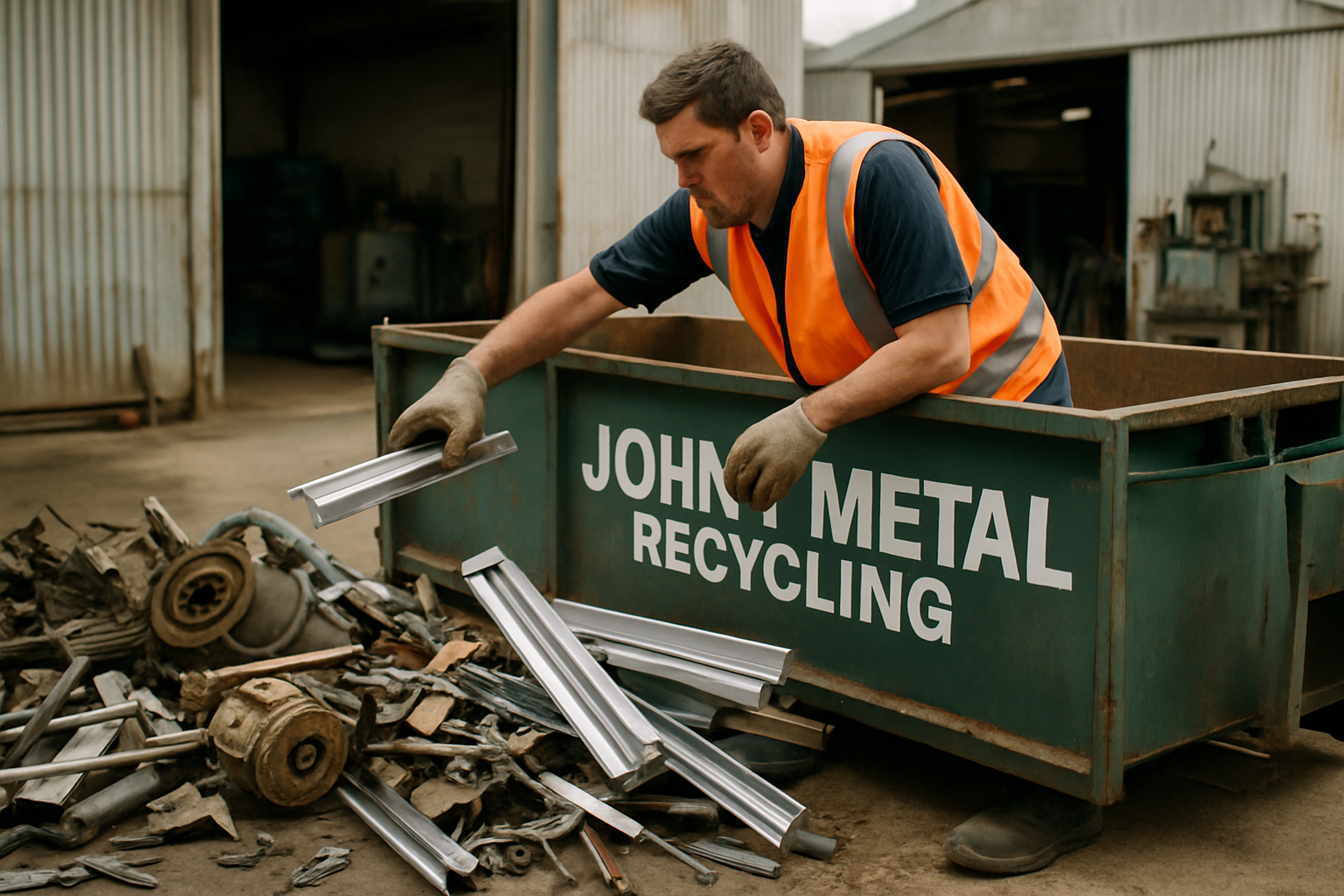
Got old steel, copper pipe, aluminium offcuts, or a pile of mixed metals taking up space? There’s a good chance someone will collect it for free and, in many cases, hand you cash on the spot. Free scrap metal pickup in Melbourne is a genuine, working service. It’s available to more customers than most people expect.
This guide covers exactly who qualifies, what materials are accepted, how minimum quantity thresholds work in practice, and what to do when you’re ready to book. Whether you’re running a fabrication workshop in Dandenong, clearing a construction site in Werribee, or dealing with a shed full of accumulated metal in Melbourne’s outer suburbs, here’s what you need to know before you pick up the phone.
Why Free Scrap Metal Pickup Is Worth Knowing About
Getting rid of metal waste through conventional channels costs more than most people realise. Skip bin hire across Melbourne runs anywhere from $300 to $700 or more, depending on bin size and suburb. Council hard rubbish collections are infrequent. Usually once a year per property. They’re not built to handle commercial volumes either. Landfill tipping fees add real cost for commercial loads, and metal sitting on a worksite isn’t just an eyesore. It’s a safety liability.
Free scrap metal pickup cuts through all of that at no charge. The recycler collects your material, processes it, and earns revenue from the metal itself. That’s the whole business model. You get a cleared site, a potential cash payment, and an outcome that keeps metal out of landfill entirely.
According to the Australian Bureau of Statistics (ABS) Waste Account, Australia, Experimental Estimates (2020), Australia generated approximately 2.5 million tonnes of metal waste in the 2018–19 reference year, with a significant share recovered through recycling rather than sent to landfill. Sustainability Victoria’s Circular Economy Act: Waste and Resource Recovery Infrastructure Plan (2022) notes that metal recycling substantially reduces the need for virgin material extraction and saves considerable energy compared to producing new metal from raw ore.
For businesses especially, the value isn’t purely financial. It’s operational. One call and the problem is handled.
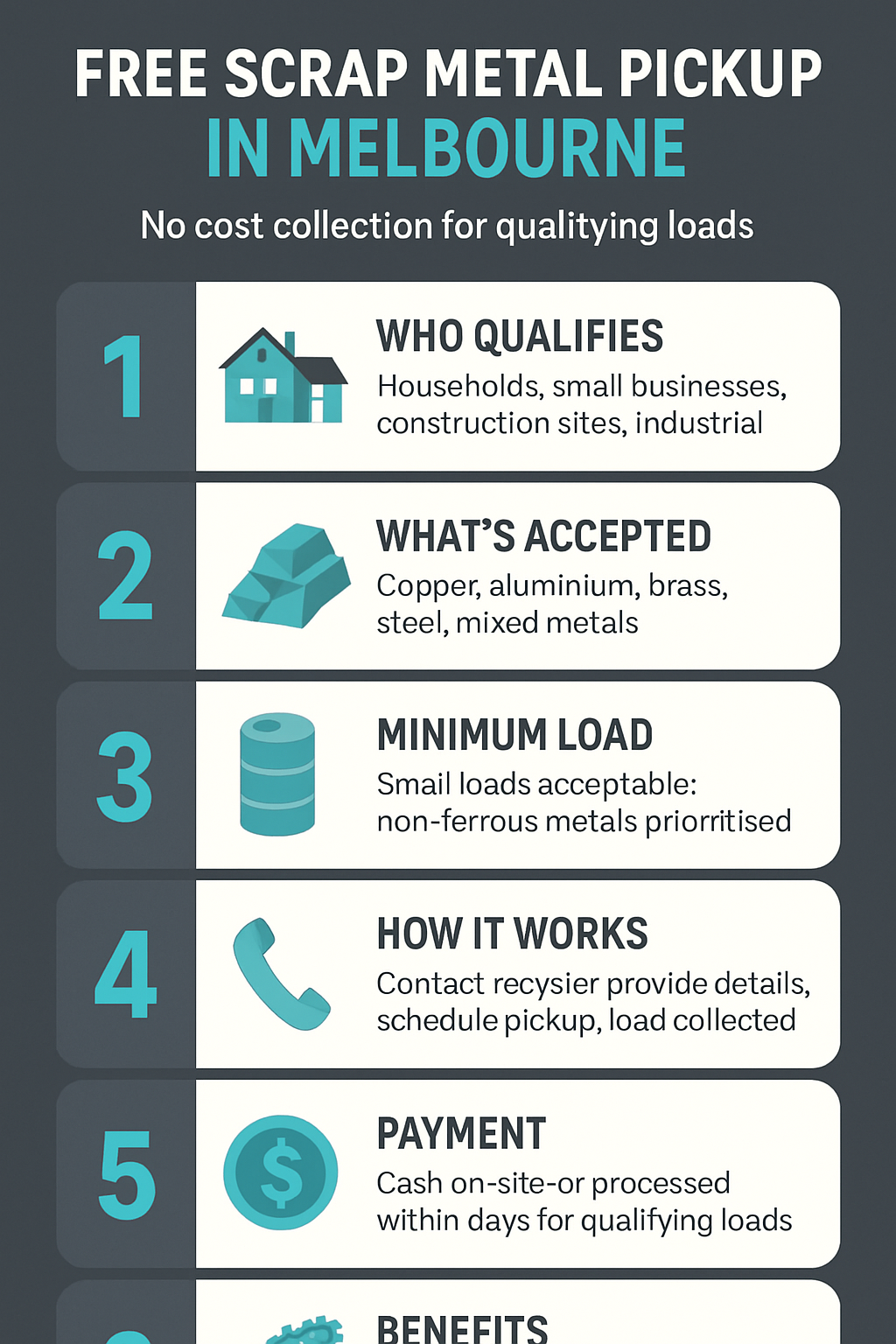
How Free Scrap Metal Pickup Works in Melbourne
The mechanics are straightforward. It helps to understand what happens behind the scenes when you contact a recycler and request a collection.
What Happens When You Book a Collection
You contact the recycling company by phone, online form, or email, and provide details about what you have. The recycler will ask about material types, approximate quantities, and your location. Based on that, they assess whether the load justifies dispatching a truck and crew.
If it qualifies, a collection time is booked. On the day, the team arrives with a truck suited to your load size, loads the metal, and either pays you on the spot or processes payment shortly after. For a straightforward residential or small commercial load, the whole thing can take as little as 30 minutes from arrival to departure.
How Recyclers Decide Whether Pickup Is Free or Fee-Based
Recyclers apply simple commercial logic. The value of the metal collected needs to offset the cost of the truck, fuel, labour, and time. When the metal value exceeds those costs, the pickup is free. When it doesn’t, usually because the load is too small or the metal is low-grade, a collection fee may apply, or pickup might not be offered at all.
This is why non-ferrous metals like copper, aluminium, and brass are almost always eligible for free pickup. A small bundle of mixed low-grade steel, though, might not be. Understanding this helps you set realistic expectations and, where possible, prepare your load to get the best outcome.
Who Qualifies for Free Scrap Metal Pickup in Melbourne
Free collection isn’t reserved for any single type of customer. It’s available across a broad range of situations, as long as the material and quantity meet the recycler’s threshold.
Residential Households
Households clearing out garages, sheds, or backyards are a common source of scrap collections. Old hot water systems, whitegoods frames, garden furniture, fencing, roofing iron, and car parts all regularly qualify. A full shed clean-out will typically have no trouble hitting minimum quantity requirements. It happens more often than people think.
Small and Medium-Sized Businesses
This is where free pickup delivers its clearest practical value. Businesses in manufacturing, fabrication, automotive, HVAC, electrical, and plumbing trades regularly accumulate scrap metal offcuts, failed components, end-of-life tools, and redundant equipment. A mechanical workshop with a trailer-load of mixed metals is an ideal candidate.
Regular scheduled collections can also be arranged for businesses generating ongoing metal waste. It keeps your site clear without any ongoing cost or administrative overhead. Learn more about our commercial scrap metal pickup service to see how recurring collections work in practice.
Industrial and Commercial Sites
Larger operations, factories, processing plants, and warehouses often produce significant volumes of ferrous and non-ferrous scrap as part of normal operations. These sites almost always qualify for free pickup. The quantities involved frequently result in meaningful cash payments at collection. Industrial customers can often negotiate collection schedules that align with their production cycles, which makes the arrangement considerably more convenient.
Construction and Demolition Projects
Building and demolition sites generate substantial scrap: structural steel, reinforcing bar, copper wiring, aluminium frames, and more. Free collection suits this context well. Materials are typically present in volume, and clearing them before the next phase of work is a practical necessity.
What Types of Scrap Metal Are Accepted for Free Collection
Not all metal is equal from a recycling perspective. Understanding the difference helps you quickly work out whether your load qualifies.
Ferrous Metals Commonly Accepted
Ferrous metals are those that contain iron, think mild steel, stainless steel, cast iron, and structural steel. These are accepted for free collection when present in sufficient quantity. Steel beams, reinforcing bar, car bodies, metal shelving, and appliance frames are typical examples.
Non-Ferrous Metals That Attract Free Pickup
Non-ferrous metals, those without iron, carry significantly higher market value. Recyclers are motivated to collect them even in moderate quantities. Commonly accepted non-ferrous metals include:
- Aluminium: cans, extrusions, cast components, wheels, sheet
- Copper: pipe, wire, motors, bus bar
- Brass: fittings, taps, valves
- Gunmetal: bearings, bushings, marine components
- Stainless steel: commercial kitchen equipment, processing tanks
If you’ve got copper pipe or aluminium extrusions sitting around, getting those collected for free, and often with payment attached, is highly achievable even for moderate quantities.
Materials That May Not Qualify for Free Collection
Some materials either lack sufficient value to justify a free pickup or create complications during processing:
- Heavily contaminated or mixed metal-and-non-metal waste
- Very small quantities of low-grade steel
- Metals with significant plastic, rubber, or other attachments that haven’t been stripped
- Certain battery types, depending on chemistry and condition
If you’re unsure, the simplest approach is to contact Johny Metal Recycling directly and describe exactly what you have. The team can advise whether your load qualifies and whether any preparation is needed beforehand.
Minimum Quantity and Load Requirements You Should Know
Why Minimum Thresholds Exist
Running a pickup truck with a driver and crew member costs money every hour. Add fuel and loading time, and a very small load can easily cost more to collect than the metal is worth. Most Melbourne scrap metal recyclers apply a minimum quantity threshold. Some state it explicitly. Others assess loads case by case. Either way, the logic is the same.
How to Estimate Whether Your Load Qualifies
A useful rule of thumb: if you can fill a ute tray or more with metal, you’re likely in the ballpark for a free pickup, particularly if non-ferrous metals are part of the mix. For purely ferrous loads like structural steel, the bar is generally higher. A tonne or more is a safer starting point.
Not sure how to assess your material? Our guide on how to sort and prepare scrap metal before recycling walks through the process of estimating and categorising your load before you make the call.
What to Do If Your Load Is Too Small
A few practical options exist when your volume doesn’t quite meet the threshold.
Combine loads. If neighbouring businesses, tenants, or nearby trades also have scrap accumulating, aggregating material into a single collection can push you over the threshold. Most people with scrap sitting around are happy to have it gone.
Drop off directly. Johny Metal Recycling accepts drop-offs at the facility for loads that don’t justify a truck run. For smaller quantities, this is often the most efficient solution.
Wait and accumulate. If you’re generating scrap regularly, store it safely and schedule a collection once you’ve built up a sufficient load. Many businesses do this naturally once they understand how the threshold works.
Geographic Coverage: Does Your Melbourne Suburb Qualify
Metro Melbourne Coverage
Free scrap metal pickup is broadly available across metropolitan Melbourne. Johny Metal Recycling services a wide range of suburbs for free collection, spanning inner-city areas and major suburban corridors to the north, south, east, and west.
Outer Suburbs and Regional Considerations
Coverage becomes more variable as you move further from Melbourne’s core. Distance affects the economics of a truck run, so recyclers are more selective in outer suburban and peri-urban areas. That said, if the load is large enough, a full site clearance or a significant commercial haul, free pickup can still be viable well outside the inner metro area.
The best approach is to contact JM Recycling directly with your suburb and an honest estimate of your load. Don’t assume you’re too far out. In many cases, a good-sized load tips the equation in your favour.
Can You Get Paid for Your Scrap Metal at the Same Time
How Scrap Metal Pricing Works
Scrap metal prices fluctuate based on global commodity markets. Copper, aluminium, and brass are priced against London Metal Exchange (LME) benchmarks daily, with local Australian adjustments applied. The LME sets a baseline spot price, and local recyclers then factor in processing costs, transport, and current demand before arriving at the rate they offer you.
The rate you receive depends on the metal type, grade, and quantity, as well as how much processing the recycler needs to do before the material can be sold on. Clean copper wire, for example, can fetch several dollars per kilogram at current LME-linked rates. Mixed low-grade steel typically returns a fraction of that. The gap matters when you’re deciding how much effort to put into sorting your load before pickup.
For a clearer picture of what your specific materials might fetch, check out our scrap metal pricing and materials guide for current rates on common metals.
Metals That Typically Attract Payment on Collection
The following materials consistently attract cash payment alongside free pickup:
- Copper (wire, pipe, motor windings): highest per-kilo rates
- Aluminium (clean extrusions, wheels, sheet): strong per-kilo return
- Brass and gunmetal: solid mid-range returns
- Stainless steel: good value in commercial quantities
For a detailed breakdown, read our blog on what metals are worth the most at scrap yards in Melbourne before you book. It helps you understand what you have and set realistic expectations going in.
How to Prepare Your Scrap Metal Before the Pickup Team Arrives
Good preparation makes the collection faster and safer. In many cases, it also increases what you’re paid. Clean, sorted metal attracts better rates than mixed or contaminated loads, sometimes meaningfully so.
Sorting and Separating Metals
Where possible, separate your ferrous and non-ferrous metals into distinct piles or containers. Keeping copper separate from steel, and aluminium separate from mixed alloys, allows the collection team to process your load more efficiently and gives you a cleaner quote.
Even a rough sort makes a genuine difference. Something like: “this pile is copper pipe, that pile is aluminium sheet, those are steel offcuts.” It takes only a few minutes and consistently results in a faster, smoother collection.
Safety and Access Requirements
Make sure the collection team can safely reach the metal. That means:
- Clear vehicle access to the site, with a driveway, gate, or loading area wide enough for a truck
- Metal that isn’t obstructed by other materials, structures, or parked vehicles
- Any sharp edges or unstable piles flagged in advance
- Asbestos, hazardous materials, or chemical contamination disclosed before arrival
That last point isn’t optional. Disclosure of hazardous materials is a legal obligation under Victorian EPA guidelines, not a courtesy. Failing to disclose creates genuine liability for the site owner.
What to Have Ready When the Team Arrives
Be on-site, or have someone authorised to provide access. Have an approximate weight or description of the material ready if you’ve estimated it. If you’re expecting payment, have ID available. The more organised your end of things, the quicker the process runs for everyone.
Real-World Examples: What a Collection Actually Looks Like
It helps to see how this plays out in practice. The following two scenarios reflect the kinds of collections Johny Metal Recycling handles regularly.
A fabrication workshop in Melbourne’s south-east had accumulated roughly 800 kg of mixed material over several months: steel offcuts, aluminium extrusions, and copper pieces from maintenance work. The owner sorted the load loosely into three piles before the team arrived. Collection took around 45 minutes. The copper and aluminium attracted a cash payment. The steel was collected at no charge. The business now runs a quarterly pickup to keep the yard clear without any fuss.
A residential property in Melbourne’s western suburbs was being prepared for renovation. The owner had two old hot water systems, steel fencing from a knocked-down boundary fence, and aluminium garden furniture that had been sitting in the backyard for years. Total weight came in at just over 300 kg. The aluminium qualified the load for free pickup with a modest payment. The steel came along as part of the same run. Start to finish, the collection was done in under an hour.
These aren’t exceptional cases. They’re typical of what free pickup looks like when a load is reasonably prepared and the material mix includes at least some non-ferrous metal.
How to Book a Free Scrap Metal Collection with Johny Metal Recycling
Step-by-Step Booking Process
- Contact JM Recycling by phone or through the website booking form at jmrecycling.com.au
- Describe your material: metal type, approximate quantity, and condition
- Confirm your location: suburb and site access details
- Receive a collection quote: confirmation of whether pickup is free and whether payment applies
- Lock in a date and time: the team works around your schedule
What Information to Have on Hand
Before you call or submit the form, it helps to know:
- What types of metal you have (even a rough description is fine)
- An approximate quantity, in kilos, ute loads, or cubic metres; any honest estimate helps
- Your suburb and the site access situation
- Whether you need a same-week booking or can be flexible on timing
What to Expect on Collection Day
The JM Recycling team will arrive in a truck suited to your load size. They’ll assess the material on arrival, load it, and discuss payment if applicable. Most residential and small commercial pickups are completed within an hour from arrival. You’ll receive confirmation of what was collected and any payment due.
Why Melbourne Businesses Choose Professional Scrap Metal Pickup Over Skip Bins or Hard Rubbish
The comparison is worth spelling out clearly. Skip bins cost money upfront, require advance arrangement, and often exclude metal weight from standard pricing. Council hard rubbish collection happens on a fixed annual schedule. It isn’t built for commercial quantities of metal.
Professional scrap metal pickup is free when your load qualifies. It can be arranged within days. It often returns money to your pocket rather than taking it. There’s no landfill involvement either. Metal recovered through recycling re-enters the materials supply chain, reducing the environmental cost of producing new metal from raw ore.
For businesses tracking waste compliance or sustainability reporting, it also provides a documented, traceable disposal pathway rather than a skip that disappears to a general waste facility. That matters more than most people realise when environmental reporting obligations are involved.
The operational point is simple. One phone call. One truck. The problem is gone. That’s genuinely hard to match with any other disposal method available in Melbourne.
Frequently Asked Questions About Free Scrap Metal Pickup in Melbourne
Is free scrap metal pickup available across all Melbourne suburbs?
Johny Metal Recycling services a broad range of Melbourne metro suburbs for free collection. Coverage can vary depending on distance and load size. Contact JM Recycling directly to confirm whether your suburb falls within the free pickup zone.
What is the minimum amount of scrap metal needed for a free pickup?
Most Melbourne scrap metal recyclers apply a minimum quantity threshold before free collection applies. The exact threshold varies by provider and material type. As a general guide, a ute tray or more of mixed metals, or a tonne-plus of ferrous material, is a reasonable starting point. Johny Metal Recycling can advise based on your specific load during the booking enquiry.
What types of scrap metal are accepted for free collection in Melbourne?
Commonly accepted materials include aluminium (cans, extrusions, cast, wheels), copper, brass, gunmetal, steel, and car bodies. Non-ferrous metals such as copper and aluminium carry higher value and are more reliably eligible for free pickup. Contaminated metals or mixed waste with significant non-metal content may not be accepted.
Will I get paid when my scrap metal is collected?
Payment depends on the type and quantity of metal being collected. High-value non-ferrous metals like copper and aluminium typically attract cash payment at or shortly after collection. Johny Metal Recycling offers competitive rates and can give you an estimate based on your materials before the booking is confirmed.
Do businesses qualify for free scrap metal pickup in Melbourne?
Yes. Free pickup is available for commercial, industrial, and construction businesses, not only residential properties. Businesses clearing workshop scrap, manufacturing offcuts, or end-of-life equipment are typically eligible. Regular scheduled collections can also be arranged for businesses generating ongoing metal waste.
How quickly can a pickup be arranged?
Booking lead times vary depending on location, load size, and current scheduling. Contact Johny Metal Recycling directly to discuss availability. Having your material type and approximate quantity ready before you call will speed things up considerably.
Can scrap metal be dropped off instead of collected?
Yes. Johny Metal Recycling accepts drop-offs at the Melbourne facility for loads that don’t suit a collection run. Drop-off is often the most practical option for smaller quantities that don’t meet the minimum threshold for free pickup. Check the JM Recycling website for the facility address, accepted materials, and operating hours.
Ready to Clear Your Scrap Metal? Book a Free Collection Today
Free scrap metal pickup in Melbourne is a practical, no-fuss solution for households, trades, SMEs, and industrial operations alike. The key is knowing what you have, whether your load qualifies, and how to get the booking done efficiently.
Johny Metal Recycling provides free scrap metal collection across Melbourne, accepts a wide range of ferrous and non-ferrous materials, and pays competitive rates on high-value metals. Whether you’ve got a one-off site clearance or need a recurring commercial collection arrangement, the team can work around your schedule and your load size.
Get in touch with Johny Metal Recycling today. Visit jmrecycling.com.au or call the team directly to describe your material, confirm your location, and lock in a collection date. The sooner you call, the sooner that space is yours again.