

Most people hand over their keys, watch the tow truck pull away, and never think about it again. That moment feels like the end of the story. It is actually the beginning of one.
What follows is a detailed, regulated process that most vehicle owners know very little about. Whether you have an old ute rusting in the driveway, a flood-damaged sedan taking up space in the garage, or a fleet vehicle that has finally reached the end of its working life, the recycler you choose will determine whether your vehicle is handled responsibly or ends up contributing to illegal dumping and serious environmental harm.
At Johny Metal Recycling, we process hundreds of end-of-life vehicles every year across Melbourne. We work with individual owners, small businesses, and fleet operators. This article walks you through the full process, from the moment your car is collected to the point where its materials re-enter the manufacturing supply chain. We want you to understand exactly what happens, and why choosing the right operator matters far more than most people realise.
The Moment Your Car Leaves the Driveway
When a car removal service collects your vehicle, it goes to a licensed recycling facility. What happens next varies significantly depending on who you handed your keys to.
A reputable, licensed metal recycler follows a structured process that complies with Victorian environmental regulations. It is designed to recover maximum value from the vehicle while keeping hazardous materials out of the environment. An unlicensed or informal buyer may not follow any of these steps. That creates real risks: illegal fluid disposal, unregistered vehicle trading, and environmental contamination.
Choosing the wrong operator is not just bad for the environment. It can also create legal liability for you as the previous owner.
The five-step process below reflects how a legitimate car removal and recycling operation handles your vehicle in Melbourne.
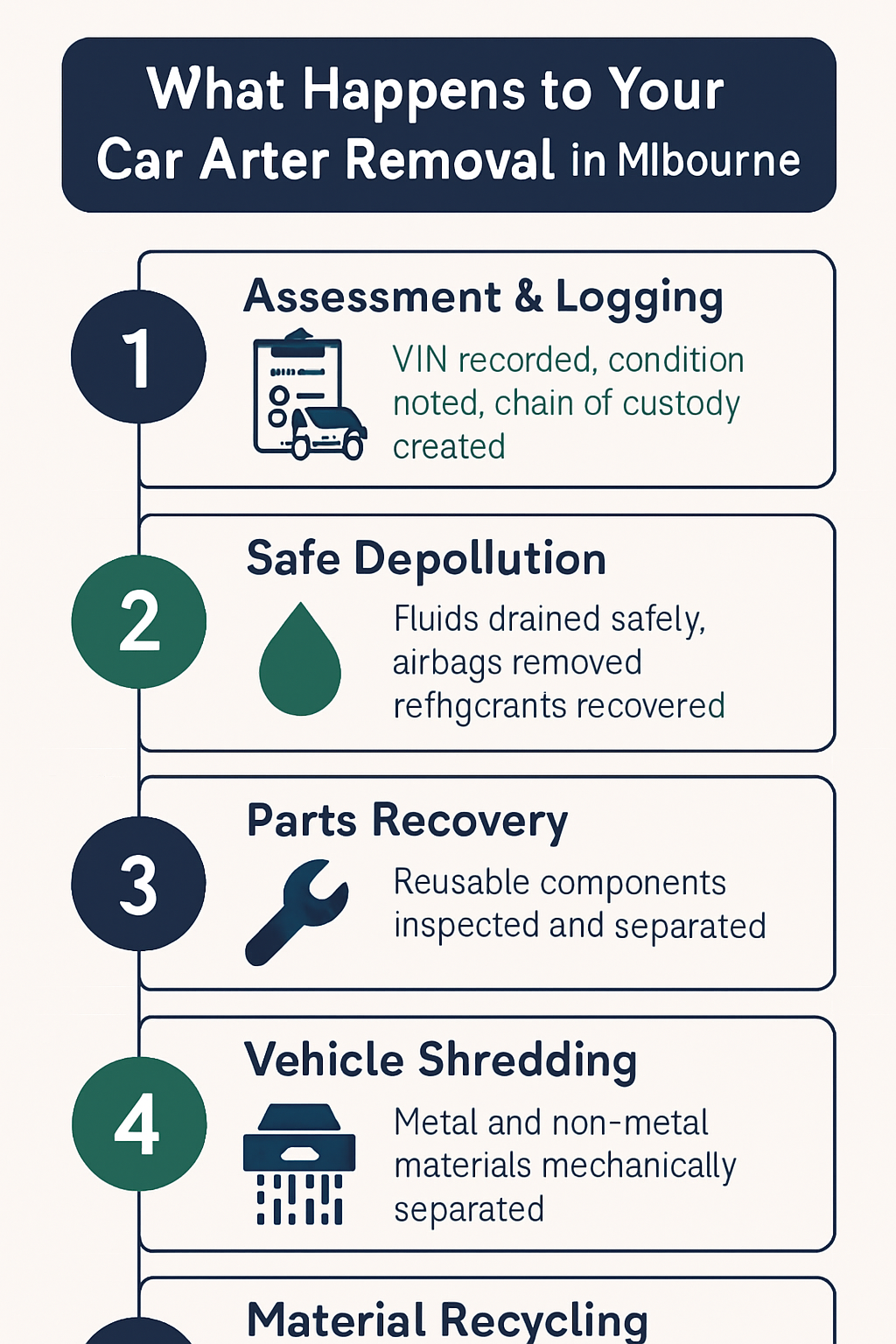
Step 1: Initial Assessment and Vehicle Logging
Why Every Vehicle Gets Assessed Before Processing Begins
Before anything else happens, every vehicle arriving at our facility is assessed. This is not just paperwork. It determines how the vehicle will be processed and what value can be recovered from it.
The assessment covers make, model, year, condition, and the presence of reusable components. A 2015 Toyota HiLux with a working engine and intact doors is processed very differently from a 2003 Holden Commodore stripped bare after a collision. Both have value. But that value comes from very different places.
What Information Is Recorded at Collection
At the point of collection, we log the vehicle identification number (VIN), registration details, and condition notes. This creates a documented chain of custody. It confirms the vehicle has been legitimately transferred and is no longer the seller’s legal responsibility.
For businesses disposing of fleet vehicles, this documentation is particularly important. It provides a clear, dated record of the disposal that may be relevant to your insurance, tax, or environmental reporting obligations. We provide this paperwork as a standard part of every collection. No chasing us up for it afterwards.
Step 2: Safe Depollution
Removing Hazardous Fluids and Materials
This is the step where responsible recyclers separate themselves from careless operators. Before any vehicle is shredded or broken down for parts, it must go through depollution. That means removing all hazardous fluids and materials and disposing of them safely.
Depollution is not optional under Victorian regulations. It is a legal requirement for licensed facilities, and skipping it is one of the clearest signs you are dealing with an unlicensed operator.
Which Fluids Are Drained and Why It Matters
A standard passenger vehicle contains somewhere between five and ten litres of engine oil, coolant, brake fluid, power steering fluid, fuel, and transmission fluid combined. These fluids are toxic. If they are not properly removed, they can leach into soil and groundwater and cause serious, sometimes irreversible environmental damage.
During depollution, each fluid is drained separately into designated containers for recycling or licensed waste disposal. Used engine oil, for example, can be re-refined into lubricating oil or used as an industrial fuel. It does not need to go to landfill. Getting this step right is the difference between responsible recycling and a quiet environmental disaster.
Handling Batteries, Airbags, and Refrigerants Safely
Several other components in your vehicle also require careful handling before anything else can happen.
Batteries: Lead-acid batteries contain sulphuric acid and lead, both classified as hazardous materials. We remove them and send them to specialist battery recyclers who recover the lead and neutralise the acid safely.
Airbags: This one surprises people. Undeployed airbags contain small explosive compounds. If a vehicle goes through the shredder with airbags still installed, they can detonate inside the machine. That is a serious safety hazard for workers and equipment. Licensed facilities remove and either deploy or dispose of them through approved channels before anything goes near the shredder.
Refrigerants: Air conditioning systems contain refrigerant gases, including R134a and newer HFO-based refrigerants. These are potent greenhouse gases. Licensed technicians use recovery equipment to capture these gases before the system is disassembled. Simply cutting the lines and venting them to atmosphere is illegal, and for good reason.
Environmental Obligations Under Victorian Regulations
In Victoria, the handling of used oil and hazardous automotive waste is governed by EPA Victoria. Businesses and facilities that handle these materials must comply with EPA requirements covering storage, transport, and disposal. EPA Victoria publishes guidance on the management of used oil and hazardous automotive waste, which is worth reviewing if you are making disposal decisions for a business fleet.
Choosing a licensed recycler means your vehicle’s fluids and hazardous components are handled in full compliance with these obligations. Not tipped down a drain. Not left to seep into the ground.
Step 3: Salvaging Reusable Parts
Once a vehicle is depolluted, it moves to the wrecking stage. Technicians remove components that can be resold or reused. This is one of the most valuable steps in the entire process, both economically and environmentally. It is also often the part that surprises people most.
Which Parts Are Typically Recovered and Resold
The list of recoverable parts is longer than most people expect. Depending on the vehicle’s condition, the following components are commonly removed and assessed for reuse:
- Engines and gearboxes
- Alternators, starter motors, and other electrical components
- Doors, bonnets, and body panels (if undamaged)
- Headlights, tail lights, and mirrors
- Seats and interior trim
- Wheels and tyres
- Radiators and cooling system components
- Catalytic converters, which contain valuable platinum group metals
High-demand vehicles, particularly popular utes, SUVs, and commercial vehicles, often yield a significant number of parts that go straight back into the second-hand parts market. Into the hands of mechanics and vehicle owners who need them, at a fraction of the price of new.
How Reusable Parts Benefit Other Vehicle Owners
When your car’s engine gets a second life in another vehicle, two things happen at once. The person buying that engine pays a fraction of what a new one would cost. And the demand for a newly manufactured replacement drops, saving the energy and raw materials that would have gone into making it from scratch.
This is the real environmental dividend of proper vehicle recycling. It is not just about melting steel. It is about extending the useful life of components that still have genuine, practical value.
The Difference Between Wrecking and Recycling
These two terms are often used interchangeably, but they describe different stages. Wrecking refers to the removal and resale of reusable parts. Recycling refers to processing what remains, the shell and residual materials, into raw inputs for remanufacturing.
Most end-of-life vehicle processing involves both stages. The wrecking stage happens first, and whatever is left goes to recycling. A business that only does one without the other is leaving value on the table and, in many cases, not handling residual materials appropriately.
Step 4: Shredding and Metal Separation
After usable parts are removed, what remains is the vehicle body. Typically a mix of steel, aluminium, and other materials. This goes into an industrial shredder.
What Happens Inside a Metal Shredder
An automotive shredder is a large, powerful machine that reduces a vehicle body to fist-sized fragments in seconds. The shredding process breaks down steel panels, frame members, and other metal components into pieces small enough to be efficiently sorted and processed downstream.
Modern shredders at Australian facilities can process hundreds of vehicles per day. The output is a mixed stream of ferrous metals (steel and iron), non-ferrous metals (aluminium, copper, zinc, and magnesium), and shredder residue, which includes plastics, rubber, glass, foam, and other non-metals.
How Ferrous and Non-Ferrous Metals Are Separated
Separation happens through a combination of magnetic and sensor-based sorting systems. Powerful overhead magnets pull ferrous metals out of the stream. Steel clings to the magnet and is collected separately. What passes through is then processed by eddy current separators and optical sorters that identify and separate aluminium, copper, and other non-ferrous metals by type.
This level of separation matters commercially as well as environmentally. Different metals go to different downstream processors and attract different prices. Mixing ferrous and non-ferrous materials reduces the value of both.
Where the Recovered Metal Actually Goes
Sorted steel is baled or compacted and sent to steel mills for remelting. In Australia, some of this material is processed domestically, but a significant proportion is exported, particularly to steel mills in Asia. Aluminium, copper, and other non-ferrous metals are sold to smelters and foundries.
The recovered metal re-enters the manufacturing supply chain, eventually ending up in new vehicles, construction materials, appliances, and a wide range of other products. This is the core function of our metal recycling services: turning what was once your car into raw material for the next generation of manufactured goods.
Step 5: Responsible Disposal of Non-Metal Materials
Not everything in a car is metal. Once the metals are recovered, the remaining shredder residue contains a range of non-metal materials that need their own disposal pathways.
Plastics, Glass, Rubber, and Foam
Plastics: Dashboard components, trim panels, and bumper bars are largely plastic. Some types can be recycled, particularly polypropylene, but automotive plastics are often mixed grades, which complicates the process considerably. Some material goes to energy recovery. Some, unfortunately, goes to landfill. Minimising this stream is a key focus for the recycling industry, and processing technology is improving steadily.
Glass: Windscreens and windows are either laminated or toughened glass. Toughened glass can be recycled into aggregate used in construction. Laminated windscreen glass is harder to process because of the plastic interlayer, but specialist processors do handle it.
Rubber: Tyres, if not already removed and resold, along with rubber seals and hoses, go to tyre recycling facilities. The rubber is processed into crumb rubber used in sporting surfaces, playground equipment, and road construction.
Foam: Seat foam is typically polyurethane, which is difficult and costly to recycle. It often ends up in landfill unless specialised foam recycling options are available locally. This is an area the industry is still working to improve.
Minimising Landfill Through Proper Sorting
According to the Australian Automotive Recyclers Association, modern vehicle recycling can recover over 80 per cent of a vehicle’s total weight as reusable or recyclable material. The remaining fraction, mostly mixed plastics and foam, is what recyclers continue to work on through better sorting technology and material recovery pathways. Getting to 90 per cent is a realistic near-term target as processing technology improves.
Why the Recycling Process Matters for Melbourne Businesses
Fleet Vehicle Disposal Done Right
If you run a business with a fleet, whether that is five vehicles or fifty, end-of-life disposal is something you need to get right. Handing an old van over to an unverified buyer without proper transfer documentation creates real liability exposure. In most cases, you remain responsible for a vehicle until the disposal is properly documented and the registration is transferred or cancelled.
A licensed recycler handles this cleanly. You get documentation of the disposal, payment for the metal value, and confidence that the vehicle has been processed responsibly. For businesses managing multiple vehicles, bulk arrangements can streamline the whole process considerably. Read more about how we handle fleet and commercial vehicle disposal.
Meeting Your Environmental Duty of Care as a Business
Australian businesses have an environmental duty of care when it comes to waste disposal. This is not just good practice. It is a legal obligation. If you engage an unlicensed operator who then illegally dumps your vehicles or disposes of fluids improperly, you may not be entirely shielded from liability, particularly if it can be shown you did not take reasonable steps to verify the operator’s credentials.
Using a licensed, EPA-compliant metal recycler is the straightforward way to meet that duty of care and protect your business from exposure.
The Value of Choosing a Licensed Recycler Over an Unknown Buyer
The Melbourne car removal market is competitive. You will see offers of up to $20,000 for vehicles, same-day pickup, and instant cash advertised everywhere. Some of these operators are legitimate. Others are not.
The key question to ask any operator is whether they hold the necessary licences to handle, transport, and process end-of-life vehicles and hazardous automotive waste under Victorian regulations. A licensed recycler can answer that clearly and directly. In our experience, an unlicensed operator typically cannot.
We are members of the Autoparts Recyclers Association of Australia (ARAA), which sets industry standards for responsible vehicle processing. You can verify our licences and accreditations directly by contacting us. Any legitimate operator should be able to do the same without hesitation.
What to Do Before Your Car Is Collected: A Practical Checklist
Documents and Personal Belongings
Before your car leaves the driveway, take a few minutes to go through the following:
- Remove all personal belongings, including items in the glovebox, boot, and under the seats
- Retrieve any toll tags, these will continue to be charged if left in the vehicle
- Collect your spare key if it is stored in the car
- Locate the vehicle’s registration papers if required for the transfer
It sounds obvious. You would be surprised how often people forget the toll tag.
Notifying VicRoads After Your Vehicle Is Sold or Scrapped
Once your vehicle has been collected for recycling, you need to notify VicRoads that it has been sold or transferred. This removes your liability for any registration or traffic infringements associated with the vehicle after the disposal date. You can notify VicRoads of a vehicle disposal online through their website. It takes about five minutes. Keep a copy of the receipt or transfer documentation from the recycler as your proof of disposal.
Understanding the Cash Payment Process
Payment is made at collection, based on the agreed quote. The amount you receive depends on the vehicle’s make, model, year, condition, and current scrap metal prices at the time of collection. Vehicles with reusable parts in good condition generally attract higher offers. A vehicle that has been stripped, heavily damaged, or is an unusual make with limited parts demand will typically come in lower.
The best way to get an accurate figure is to give an honest, detailed description of your vehicle when requesting a quote. Include the condition, any damage, and whether key components are still present. Our article on how scrap metal prices are determined covers the factors that affect your payment in more detail.
How Johny Metal Recycling Handles Car Removal in Melbourne
The information in this section draws directly on the experience of our operations team, who oversee vehicle intake, depollution, and materials processing at our Melbourne facility day to day.
Our Process From Quote to Collection
Getting a quote with us is straightforward. You contact us with the details of your vehicle, make, model, year, condition, and location, and we give you an upfront offer based on an honest assessment of its value. No hidden fees. No last-minute price changes at the door. No pressure to commit on the spot.
Once you accept the offer, we arrange a collection time that suits you. Our team comes to your location anywhere across Melbourne, handles the towing, and pays you on the spot. The whole process is documented, and you get the paperwork you need to notify VicRoads and close the loop on your registration.
We service the full greater Melbourne area. From Frankston to Sunbury, Werribee to Dandenong, we come to you.
Here is a common scenario from our operations team that shows how this works in practice. Trade businesses regularly come to us to dispose of expired work vans and light commercial vehicles. A typical fleet job involving four to six vehicles is completed within a single scheduled collection run. All VIN documentation, transfer paperwork, and payment are handled on the day. No multiple trips. No outstanding admin left hanging.
Visit our car removal Melbourne service page to get a quote or find out more about how we work.
What Makes Us Different From Generic Car Removal Services
Johny Metal Recycling is a licensed metal recycler, not just a car removal service that onsells vehicles to third parties. That means your vehicle stays within a compliant, documented recycling chain from collection through to material recovery. We handle the full process: depollution, wrecking, shredding, and metal separation, all within a framework that meets EPA Victoria’s requirements.
We work with individual vehicle owners, small businesses, and larger operations with fleet disposal needs. Whether it is one old Corolla or a fleet of expired work vehicles, the process is the same: professional, compliant, and efficient.
We are members of the Autoparts Recyclers Association of Australia (ARAA) and we can confirm our licences and accreditations on request. Ask us directly. Any legitimate operator should give you a straight answer.
Wrapping Up
Most people think of car removal as a simple transaction. Hand over the keys, get some cash. The reality is far more involved. A properly managed end-of-life vehicle goes through a five-step process that recovers reusable parts, safely removes hazardous materials, extracts metals for remanufacturing, and minimises what ends up in landfill. Done well, it is one of the most complete recycling processes in any industry.
For Melbourne businesses especially, the choice of recycler matters beyond the dollar figure on the day. Compliance, documentation, and environmental responsibility are all part of the picture.
If you have a vehicle that needs to go, whether it is a single car or a business fleet, Johny Metal Recycling handles the whole process simply, transparently, and properly from start to finish.
Get a free, no-obligation quote today by contacting the Johny Metal Recycling team. We service Melbourne and surrounding areas, and we will give you a straight answer on what your vehicle is worth.
Frequently Asked Questions
What actually happens to my car after it’s collected for removal in Melbourne?
The vehicle is assessed and logged when it arrives at the recycling facility. Hazardous fluids, including oil, coolant, brake fluid, and fuel, are safely drained and disposed of in line with EPA Victoria requirements. Usable parts such as engines, transmissions, doors, and electronics are removed and assessed for resale. The remaining body shell goes through an industrial shredder and the metals are separated for reprocessing. Non-metal materials like plastics, rubber, and glass are sorted and directed to appropriate disposal or recycling streams.
Is car removal in Melbourne environmentally safe?
When handled by a licensed metal recycler, yes. Depollution steps ensure harmful fluids and chemicals are removed before shredding begins, and licensed operators must comply with EPA Victoria guidelines for handling hazardous automotive waste. Choosing a reputable recycler like Johny Metal Recycling means your vehicle is processed responsibly and does not contribute to illegal dumping or environmental harm.
How much can I get paid for my unwanted car in Melbourne?
Payment depends on the vehicle’s make, model, age, condition, and current scrap metal prices. Vehicles in better condition with reusable parts typically attract higher offers. Johny Metal Recycling provides upfront quotes based on an honest assessment of your vehicle’s value, with no surprises when our team arrives.
Do I need to notify VicRoads after my car is removed?
Yes. Once your vehicle is sold or transferred for scrapping, you should notify VicRoads to avoid ongoing registration liability. This can be done online via the VicRoads website and only takes a few minutes. Keep a copy of your receipt or transfer documentation as your record of the disposal.
Can businesses use car removal services for fleet vehicles?
Absolutely. Businesses with end-of-life fleet vehicles can arrange bulk car removal to streamline disposal. A licensed recycler handles the process professionally, ensuring compliance with environmental duty of care obligations. Johny Metal Recycling works with Melbourne businesses of all sizes to manage fleet disposal efficiently and responsibly.
What types of vehicles can be collected for recycling in Melbourne?
Johny Metal Recycling accepts cars, utes, vans, 4WDs, trucks, and commercial vehicles. Vehicles in any condition, whether accident-damaged, non-running, flood-affected, or simply old, are typically accepted. The recycling process is adapted depending on the vehicle type and the condition of its components.