
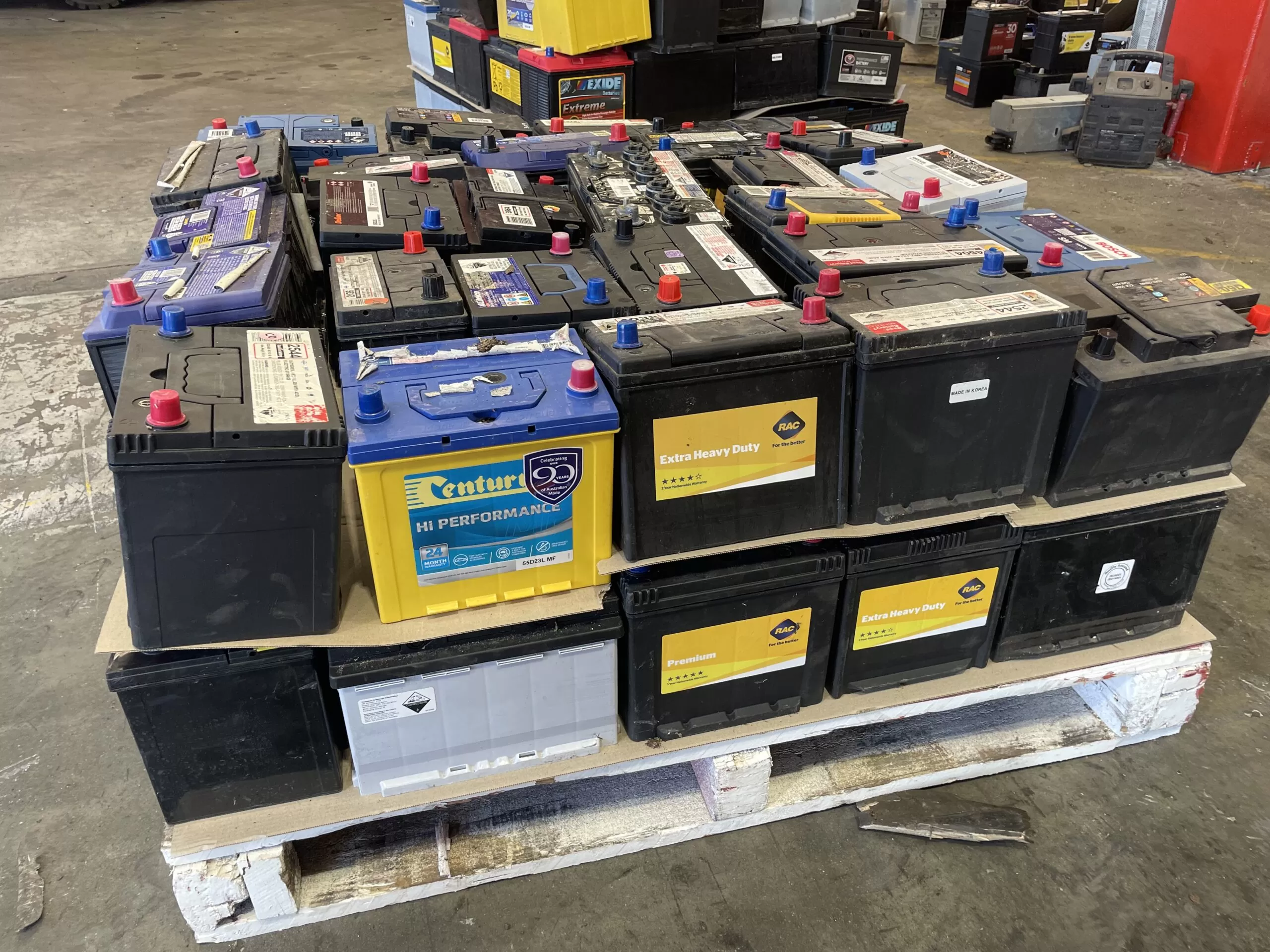
Lead has a strange reputation. It’s the metal everyone knows is toxic, and it’s also the most successfully recycled metal on the planet. Around 95% of lead-acid batteries get recycled globally, and recycled lead now supplies roughly 60% of world demand. No other metal comes close to that loop.
The reason is partly that lead is easy to recover and partly that regulators have made throwing it away extremely difficult. Either way, the battery sitting flat in your driveway is worth following through the system.
What’s actually in the battery
A standard 12V car battery is mostly lead by weight. Lead grids and connectors, lead paste (a mix of lead oxide and lead sulfate) smeared onto those grids, a polypropylene case, plastic separators, and sulfuric acid electrolyte.
Nearly all of it gets used again. Australian processors recover about 97% of the battery, with only furnace slag going to disposal.
The process, step by step
Collection. Batteries go to a licensed handler. They’re classified as hazardous waste in Australia, so they can’t legally be dropped in a bin or left with a general waste contractor.
Breaking. The battery goes through a hammer mill that smashes it apart. The pieces drop into a water bath, where separation happens by density. Polypropylene floats. Lead sinks. Acid drains off.
The acid. It doesn’t get tipped anywhere. Australian processors convert sulfuric acid into sodium sulfate, which ends up in fertiliser and laundry detergent. Some plants neutralise it instead and treat the water.
The plastic. Polypropylene case fragments are washed, pelletised, and sold back to manufacturers, a good share of it going into new battery cases. Battery to battery, same material.
The lead, in two streams. Solid lead chips and grids are relatively clean and can be melted into ingots directly. The lead paste is harder work, because it’s chemically bound as lead sulfate, so it’s desulfurised and then smelted at high temperature in a rotary or blast furnace.
Refining. Raw smelted lead carries antimony, copper, tin and arsenic. Refining strips those out, then the lead is deliberately alloyed back to whatever specification the buyer needs, because battery grids and roof flashing want different metal.
Casting. Out come ingots, which go to battery manufacturers, and the cycle starts again. A battery can go around this loop indefinitely without the lead degrading.
Australia regulates this harder than most scrap
Used lead-acid batteries sit under the Basel Convention and the OECD’s transboundary waste rules. Exporting them out of Australia requires a permit, and permits are granted rarely, on the basis that we have domestic capacity, and the batteries should be processed here.
The penalties are not decorative. Corporations face fines up to $2.22 million, and individuals up to eight years’ imprisonment.
There are four dedicated lead-acid battery recycling facilities in the country, two in New South Wales, one in Victoria and one in Queensland. So a Melbourne battery has a genuinely short trip.
Lead’s other lives
Batteries dominate, but they aren’t the whole story. Scrap lead also comes from roof flashing and sheet, old lead pipe, cable sheathing from decommissioned infrastructure, wheel balance weights, radiation shielding out of hospitals and dental surgeries, keel and diving ballast, and the came from leadlight windows.
Clean soft lead of that kind is a better grade than battery lead, because it doesn’t need the breaking and separation stage.
What it’s worth
Indicative Melbourne ranges published in mid-2026:
| Type | Indicative range |
| Clean lead (sheet, flashing, pipe, ingot) | $1.50 – $3.00/kg |
| Mixed or contaminated lead | $1.00 – $2.00/kg |
| Car battery (standard 12V) | $10 – $20 each |
| Truck or commercial battery | $30 – $50+ each |
Batteries get priced per unit or by weight rather than at a clean lead rate, because the acid and plastic have to be separated out before anyone sees the metal.
One thing worth flagging honestly. Lead was trading around US$1,905 a tonne on 17 September 2026, down about 5% on the year. Of the metals worth writing about this year, it’s the one that’s gone backwards. Recycled supply meets most of the world’s demand, which tends to cap price spikes rather than feed them. Don’t hold a pile of lead waiting for a run.
Do not process lead yourself
This is the part that matters more than the money.
The World Health Organization’s position is that there is no known level of lead exposure that is without harmful effects. It accumulates in the body. Children and pregnant women are at far greater risk, and the damage is not reversible.
So: don’t melt lead in a shed or a backyard. Don’t burn cable sheathing off. Don’t sand, grind or torch painted lead. Don’t drain battery acid, and don’t crack a battery open to get at the metal. The fume and the fine dust are the dangerous part, and neither is visible.
Sell it whole. Let a licensed facility with extraction, containment and blood monitoring do the processing. That’s what the four plants exist for.
Basic handling is straightforward enough. Keep batteries upright, don’t stack them loose in a ute where terminals can short against each other, don’t puncture the cases, and wash your hands afterwards. If one is cracked and leaking, tell the yard before you hand it over rather than after.
Selling it on
Ask which grade you’re being quoted on, and expect batteries to be priced separately from clean lead. Rates move with the global market, so a current quote beats any table, including the one above.
For a bootload of batteries off a workshop floor or a roll of old flashing off a reroof, it’s usually worth asking about collection rather than carting hazardous waste around yourself.
Johnny Metal Recycling takes lead and lead-acid batteries across Melbourne.