
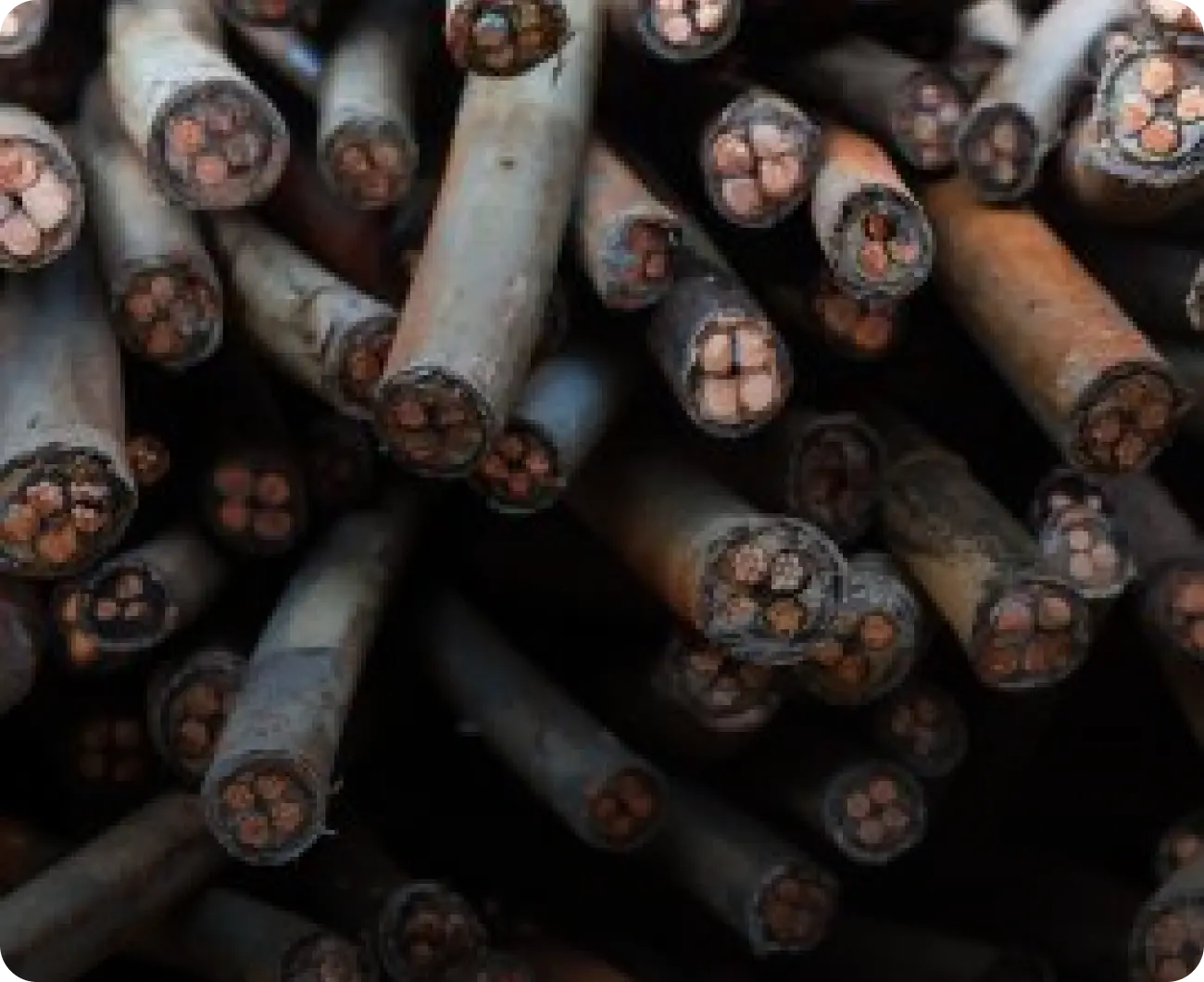
Cable is the one thing in a scrap load where what you can see is not what you’re selling. The plastic is just packaging. The copper inside is the product, and every yard in Melbourne prices cable by guessing how much of it is in there.
Get a feel for that guess, and you’ll know within a few dollars what your bundle is worth before you leave the site.
Yards pay on recovery, not on weight
When a yard quotes an insulated cable rate, they’re working off recovery: the proportion of the bundle that will still be there once the insulation is stripped off and thrown away.
Standard TPS building cable, the flat white stuff behind every wall in the country, is roughly one third to one half copper by weight. Heavy industrial and mains cable runs higher, often 50 to 70%. Thin flex, data cable and phone line are much lower, because there’s a lot of plastic wrapped around, not much metal.
That’s the whole logic. Thick conductor, thin insulation, good rate. Thin conductor, fat jacket, poor rate.
What the grades pay
Indicative Melbourne ranges from price lists published between mid-2025 and August 2026. Ring for today’s rate before you plan around any of them.
| Grade | Indicative range |
| Bare bright copper | $10.50 – $12.50/kg |
| Armoured copper cable | $5.50 – $8.00/kg |
| Heavy insulated copper cable | $4.00 – $7.00/kg |
| House wire and light insulated | $2.50 – $4.00/kg |
| Mixed or low-grade cable | $2.50 – $4.50/kg |
| Insulated aluminium cable | $0.80 – $1.80/kg |
Worth noticing: one of the lists I pulled these from was dated June 2025 and had bare copper at $8.00 to $10.00. A list from August 2026 had it at $10.50 to $12.50. Copper ran about 40% over the year to 16 September 2026, when it was trading around US$6.37 a pound. Undated price pages are a trap in both directions.
The stripping question, with actual numbers
Everyone asks whether it’s worth stripping. The honest answer depends entirely on what gauge you’re holding, and the sums are less flattering than most people assume.
Take 10 kg of TPS house wire. Sold as-is at $4 to $6 a kilo, that’s $40 to $60. Strip it, and you’ll recover maybe 4 to 5 kg of bare copper, worth $42 to $62.
That’s break-even, near enough, for what might be two hours with a knife. The yard’s insulated rate is already pricing your copper fairly. You’re not being ripped off by selling it whole, which is the opposite of what the internet tends to tell you.
Now take 10 kg of heavy mains cable at 60% recovery. That’s 6 kg of bare copper, $63 to $75, against $40 to $70 sold insulated. There the gap is real, and it gets wider the thicker the conductor.
So the rule of thumb: strip heavy cable, sell light cable whole. And if you’re generating cable regularly, a mechanical stripper changes the maths completely, because it does in one pass what a knife does in ten minutes.
Never burn it
This should not need saying, and it still does.
Burning insulation off cable is prohibited in Victoria under environmental protection law. PVC insulation gives off hydrogen chloride and dioxins when it burns, which is a genuine health hazard to you and everyone downwind, not a theoretical one.
And it doesn’t even work commercially. Burnt copper is downgraded at the yard, because the fire oxidises the surface and leaves residue the refiner has to deal with. You lose the legal argument, the health argument and the money argument in one go.
The aluminium trap
Under the insulation, aluminium conductor and copper conductor are not that easy to tell apart at a glance, particularly in older mains and overhead service cable.
Aluminium is dull grey rather than pink-orange, noticeably lighter in the hand, and pays somewhere between a fifth and a tenth of what copper does. Nick the end of a run and look before you price a job in your head. Plenty of people have loaded a ute expecting copper money.
What else drags the rate down
Mixed bundles. A bag with mains cable, data cable, flex and a few extension leads in it gets priced as mixed, which means priced near the bottom.
Steel armour and conduit left on. Connectors, plugs and transformers still attached. Mud and water, which is just weight you’re being charged to dispose of. Cable still on heavy timber or steel drums.
None of it is complicated. It’s mostly about not tipping four different products into one bag.
Where the good cable comes from
Switchboard and mains upgrades are the best of it, because that’s heavy conductor with high recovery. Factory and plant decommissioning throws off armoured and industrial cable. Solar and EV charger installs generate offcuts by the metre.
Electricians sitting on a bin of offcuts at the back of the shed are usually further ahead than they think, especially since copper’s run this year. If it’s been accumulating for a couple of years, it’s worth more now than when most of it went in.
When you sell
Cable is the most stolen metal in Victoria, so expect any decent yard to ask for photo ID and record the transaction. That isn’t suspicion; it’s the yard staying on the right side of its obligations, and a yard that doesn’t ask is one to think twice about.
Ask which grade you’re being quoted on. Ask whether the rate is picked up or delivered. And ask to see the weighbridge ticket, which any reputable operator will show you without being prompted.
Johnny Metal Recycling buys insulated wire and cable in every grade above, from a sparky’s offcut bin to full industrial strip-outs, across Melbourne.