
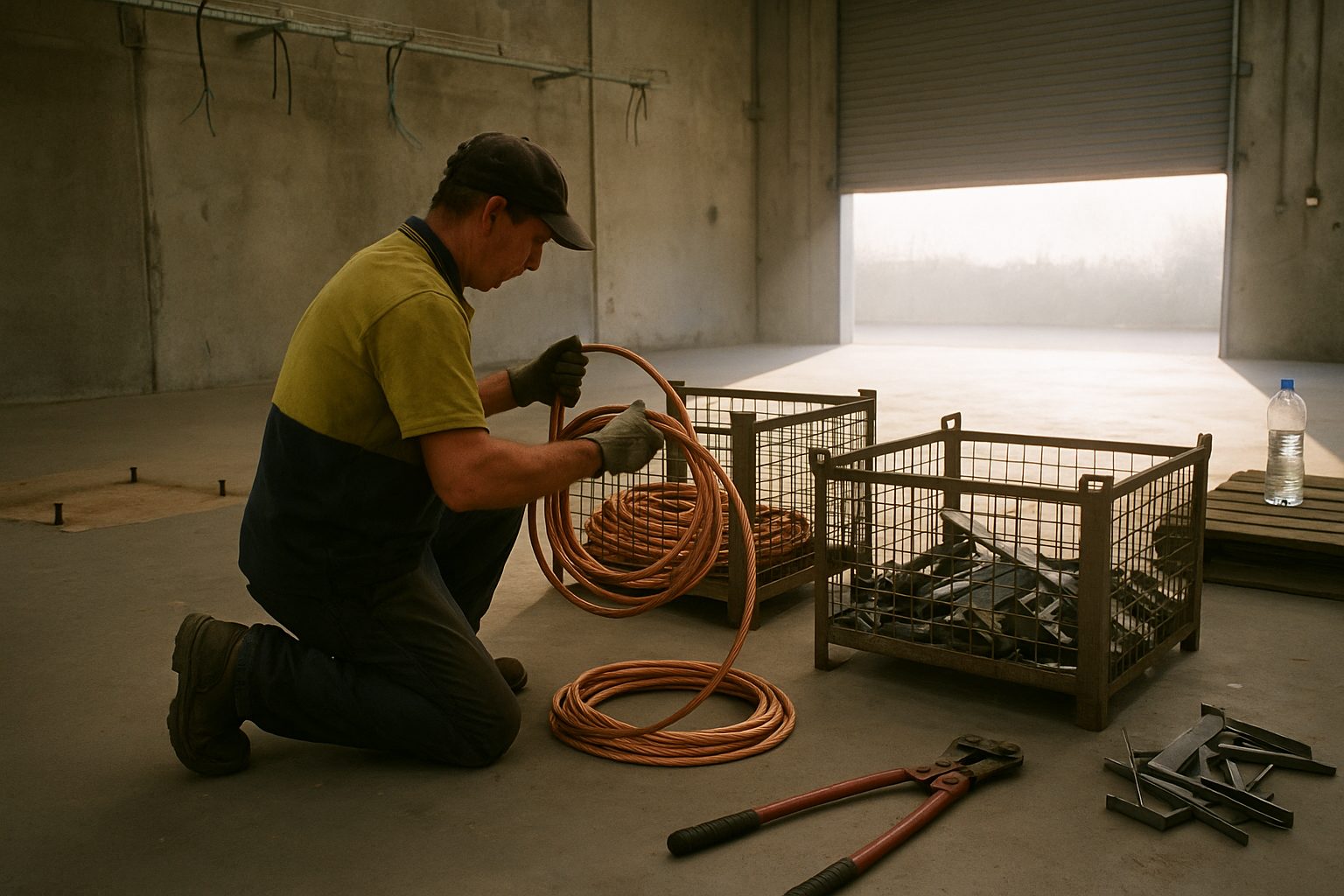
A factory demolition and a factory dismantling job can leave you with the same empty floor, but they get there in very different ways. Factory demolition knocks the structure down, and the asset is gone at the end. Factory dismantling takes the structure and its plant apart piece by piece, so machinery, racking and steelwork stay intact for reuse, relocation or sale. The right choice for your site depends on what you want to keep, how much time you have and how much value you expect to get back from your industrial scrap metal.
Australian small and medium businesses ask us about this decision constantly. One manufacturer needs to shift a production line across town. A landlord has to clear a warehouse before the next tenant arrives. An owner is closing a plant so the land can go on the market. If you make the right call, you save time, reduce risk and recover more from the metal on site. If you make the wrong one, you could end up paying a crew to flatten equipment you might have sold or reused.
This guide explains both options, how Australian safety rules treat each one, and how to plan metal recovery at every stage. It also covers how to line up industrial scrap metal removal services with the way the job actually unfolds.
Factory demolition vs factory dismantling: the short answer
The real difference is what’s left standing, or sitting on pallets, once the work is finished.
Demolition ends with the structure gone
A demolished structure is usually destroyed outright. Walls, roof sheeting, framing and anything still inside come down together, often under heavy machinery. The aim is a clear site, and speed is normally the priority.
We think demolition makes sense when nothing in the building has genuine reuse value, or when the land is the only asset you care about.
Dismantling takes the structure apart and keeps components intact
Dismantling takes the structure apart in a planned sequence. Bolted steel frames get unbolted rather than cut. Conveyors, presses and compressors are disconnected and lifted out in one piece, and pallet racking is broken down into uprights and beams that can be stacked and trucked away.
The point is to keep components in good enough condition to be reused, relocated or sold. Anything that can’t be reused is still separated cleanly for recycling as it comes out.
Why the choice matters for your budget, timeline and industrial scrap metal
You’ll notice the effects of this decision in three areas.
- Budget. Dismantling usually costs more in labour, although equipment resale and cleaner metal can win some of that back.
- Timeline. Demolition is faster. Dismantling takes longer because materials are separated and recovered as the job progresses.
- Metal quality. Dismantling generally produces better sorted industrial scrap metal. Demolition leaves you with more mixed material that has to be sorted afterwards.
What factory demolition involves
Taking a factory down safely calls for careful planning, experienced crews and tight controls. Most professional jobs follow four stages.
Stage 1: site survey and planning
Before anything comes down, the contractor surveys the site, looking at the structure, services, access points, neighbouring buildings and any hazardous materials. Plenty of older Australian factories contain asbestos, so a hazardous materials assessment usually happens at this point.
Planning also locks in the demolition method, the order of work, traffic and exclusion zones, and the destination for each type of material.
Stage 2: site preparation
Preparation makes the site safe to work on. Power, gas and water are disconnected and made safe, licensed specialists remove hazardous materials, and fencing and signage go up.
This is also your best chance to pull out anything worth saving: copper cabling, switchboards, aluminium window frames and loose machinery. Once the excavators start on the structure, those items get buried in mixed rubble and a lot of their value goes with them.
Stage 3: demolition execution
This is the stage most people imagine. Excavators with attachments bring the structure down in a controlled sequence. Steel framing, roof sheeting, masonry and concrete come down and are pushed into separate piles wherever that’s possible.
A good contractor keeps metal away from concrete and timber during this stage, even if the separation is fairly rough. It makes the next step a lot easier.
Stage 4: clearing the site and handing it back
Last of all, debris is removed, metal heads off for recycling, and the site is levelled or left in whatever condition was agreed. On a leased site, that normally means satisfying the make good clauses in your lease. If you’re selling, it means handing over a clean, safe block.
What factory dismantling involves
Factory dismantling, often called plant dismantling, is the systematic and methodical removal of plant and equipment. It treats getting the equipment out as a separate job from bringing the building down.
Systematic removal of plant and equipment
Every dismantling job starts with an inventory. Each machine, line and service run is listed along with where it’s going, whether that’s reuse, sale, relocation or recycling.
Equipment is then isolated, disconnected and removed in a logical order. Work generally moves from the top down and from the outside in. Overhead services come out before floor mounted machinery, so nothing ends up blocking the exit.
Keeping machinery, racking and steelwork in reusable condition
The real skill in dismantling lies in keeping things whole. On a typical job, that looks like:
- Labelling cables, hoses and components so equipment can be put back together at a new site
- Unbolting structural steel and mezzanine floors rather than cutting through them
- Breaking pallet racking down into matched sets of uprights and beams
- Lifting heavy machinery with suitable cranes, forklifts or skates so frames and bases don’t get damaged
- Draining oils, coolants and hydraulic fluids before anything goes on a truck
Items with no reuse value are still sorted by metal type as they come out, which gives you clean recycling streams.
Where strip outs and decommissioning fit in
People mix these terms up all the time, so it’s worth pulling them apart.
An industrial strip out removes the internal fit out, services and equipment while the building shell stays where it is. Factory decommissioning means taking installations, buildings or production lines completely out of use. In practice, decommissioning often combines equipment removal with structural removal. Australian contractors describe decommissioning work that includes taking out machinery and plant along with large chimney stacks and flues.
Decommissioning is not the same as renovation, where the factory keeps running. Strip outs, dismantling and demolition are related, but each has its own scope and needs a specialised, carefully managed approach.
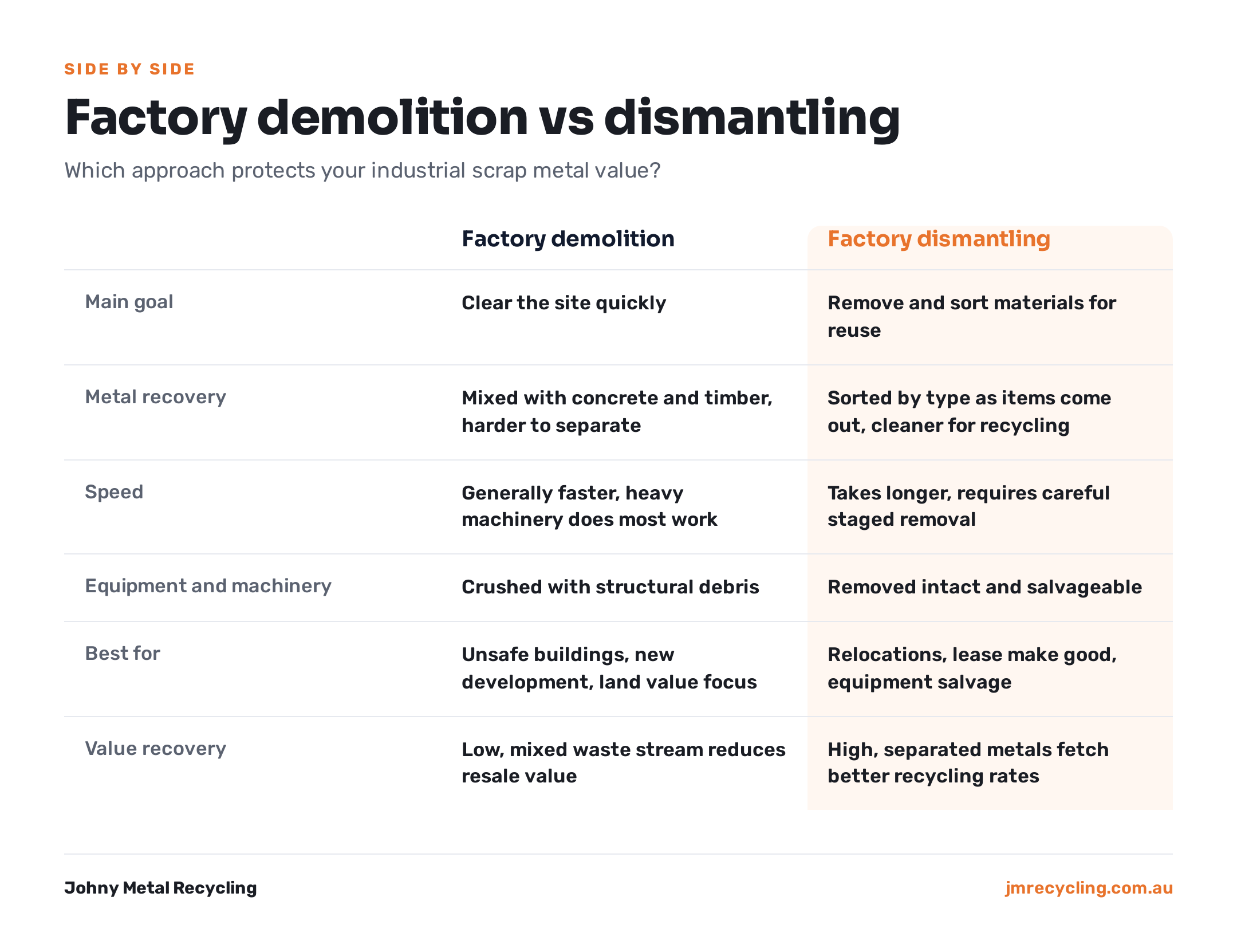
Side by side comparison: demolition, dismantling and decommissioning
Comparison table: goal, end result, speed, material recovery and typical use
The speed ratings below rest on figures attributed to the NSW Environment Protection Authority, which put deconstruction at 55 to 60 per cent longer than demolition because recyclable materials have to be separated and recovered. The recovery ratings follow from the methods described above: dismantling sorts metal as each item comes out, while demolition brings material down together for sorting afterwards.
| Demolition | Dismantling | Decommissioning | |
|---|---|---|---|
| Main goal | Clear the site | Recover components intact | Take a facility or line out of use |
| End result | Structure gone | Plant and steelwork removed in reusable condition | Equipment and often structures removed, site retired from production |
| Speed | Fastest (deconstruction takes 55 to 60 per cent longer, per NSW EPA figures) | Slower, by 55 to 60 per cent per NSW EPA figures | Varies with scope |
| Material recovery | Mixed material, sorted afterwards | Clean, well sorted streams, separated as each item comes out | Depends on whether dismantling or demolition methods are used |
| Typical use | Selling land, redeveloping, removing unsafe buildings | Relocating lines, selling equipment, lease exits | Full factory closures, plant shutdowns |
The time versus recovery trade off
At its core, you’re trading time against what you get back. Figures attributed to the NSW Environment Protection Authority put deconstruction at 55 to 60 per cent longer than demolition, because recyclable materials have to be separated and recovered.
So if a standard demolition would take four weeks, a careful deconstruction could stretch past six. Whether those extra weeks pay off depends on what your equipment and metal are worth and how fixed your deadline is. A lease that ends on a set date gives you much less breathing room than a site you own outright.
How Australian safety rules treat each type of work
This is the point where demolition and dismantling stop being two words for similar things and start carrying different obligations.
What Safe Work Australia counts as demolition work
Safe Work Australia publishes national guidance on demolition, and each state enforces work health and safety laws through its own regulator. In Victoria, that’s WorkSafe Victoria. Demolition is classed as high risk construction work, which comes with specific planning and documentation duties.
Why some dismantling falls outside the demolition definition
Safe Work Australia’s demolition guidance says demolition work does not include dismantling structures that provide support, access or containment during construction work. Scaffolding, formwork and temporary hoarding are the obvious examples.
As a result, some dismantling is treated differently from demolition. Other dismantling, such as taking down a structural steel frame, may still count as demolition depending on the structure and the method used. Labelling a job “dismantling” doesn’t automatically change its safety category, so please don’t assume it does.
Questions to confirm with your contractor before work starts
We’d recommend asking these questions before you sign anything:
- Does this job count as demolition work under the relevant rules, or does it fall outside that definition?
- Who is preparing the safe work method statement, and can we see it?
- Has a hazardous materials survey been done, including asbestos?
- Who disconnects and certifies services as safe?
- What licences does your team hold for any high risk work involved?
- How will metal, concrete and general waste be separated on site?
- Who is responsible for each scope if strip out, dismantling and demolition are handled by different contractors?
Which option suits your situation? Real business scenarios
The examples below reflect the kinds of jobs businesses come up against regularly.
Relocating a manufacturing line to a new site
A food packaging business is leaving an older factory in Melbourne’s west for a bigger site. Its fillers, conveyors and control panels all need to run again in the new building.
Best fit: dismantling. Every component is labelled, disconnected and moved in one piece. Old ducting, worn guarding and redundant cabling go to recycling as separate streams, and the building is left behind for the landlord.
Closing a factory and selling the land
A metal fabrication business closes its doors, and the owner sells the land to a developer who wants a clear block.
Best fit: staged approach, then demolition. Saleable machinery and valuable non ferrous items such as copper cabling and brass fittings come out first, and the shell is demolished afterwards. Pulling out the higher value metal before the heavy machinery arrives is what protects its value.
Upgrading old plant while the building stays in use
A plastics manufacturer is replacing two ageing injection moulding machines but needs the rest of the floor to keep producing.
Best fit: dismantling within a partial strip out. Work stays inside one zone, with exclusion areas and careful scheduling around production shifts. Because the factory keeps operating, this is closer to renovation than decommissioning.
Clearing a warehouse after a lease ends
A distribution business has to hand back a warehouse in its original condition. Inside sit pallet racking, a steel mezzanine, office partitions and old forklift chargers.
Best fit: industrial strip out with dismantling. The racking and mezzanine are unbolted, then sold, relocated or recycled as clean steel. The chargers and cabling are set aside for their copper content, and the building itself stays standing.
Getting the most from industrial scrap metal on a factory job
Whichever path you choose, a bit of planning makes recovering metal from a closure or upgrade far more efficient.
Separate ferrous and non ferrous metals early
Ferrous metals contain iron and are usually magnetic. Steel framing, racking, machine bases and roof purlins all belong in this group. Non ferrous metals such as copper, aluminium, brass and stainless steel are generally worth more per kilogram.
Set up separate bins or bays on the first day. A simple magnet test sorts most items in a few seconds. For the heavier ferrous material, our page on iron and steel recycling explains what we accept and how we handle it.
Keep copper, aluminium and steel streams clean
Clean streams are much easier to process. In our experience, these are the problems we see most often on factory jobs:
- Copper cable mixed in with steel offcuts
- Aluminium window frames still fitted with glass and rubber seals
- Steel contaminated with concrete, timber or plastic
- Motors and transformers tossed in with general scrap instead of being kept separate
Strip whatever you reasonably can on site, and give each metal type its own pile.
Plan collection around each project stage
Metal comes off a factory job in waves. The strip out produces cabling, ducting and fittings. Dismantling brings out machinery and racking, and demolition leaves structural steel and sheeting behind.
Time your collections to match each wave so bins don’t overflow and mixed material doesn’t pile up. A tidier site is also a safer one, and that matters a lot when machinery is moving around.
Practical checklist for SME owners and site managers
- Walk the site and list every piece of equipment, noting what you’ll keep, sell or recycle
- Confirm the safety category of the work with your contractor
- Arrange a hazardous materials survey before any work starts
- Set up separate areas for ferrous metal, copper, aluminium, stainless and general waste
- Remove high value non ferrous items before heavy machinery starts
- Drain fluids from machinery before it’s moved or recycled
- Schedule metal collections to line up with each project stage
- Keep records of what left the site and where it went, for your own reporting
Frequently asked questions
What is the main difference between factory demolition and factory dismantling?
Demolition usually destroys the structure completely, so the asset is gone by the end. Dismantling takes the structure apart piece by piece so components stay intact. It suits businesses that want to reuse, relocate or sell their equipment and steelwork.
Does dismantling take longer than demolition?
In most cases, yes. Figures attributed to the NSW Environment Protection Authority put deconstruction at 55 to 60 per cent longer than demolition. The extra time goes into separating and recovering recyclable materials, so factor it into your lease exit or relocation timeline early on.
Is dismantling treated as demolition work under Australian safety rules?
Not always. Safe Work Australia states that demolition work does not include dismantling structures that provide support, access or containment during construction work. Other dismantling may still count as demolition, depending on the structure and method. Check the category with your contractor and your state regulator before any work begins.
What is factory decommissioning?
Decommissioning means taking installations, buildings or production lines completely out of use. In practice it often combines equipment removal with structural removal, covering machinery, plant, chimney stacks and flues. It’s different from renovation, where the factory keeps operating.
What happens to the industrial scrap metal from a factory project?
Steel framing, machinery, cabling, ducting and racking can all be recycled. Dismantling usually produces cleaner, better sorted metal than demolition. Keeping ferrous and non ferrous streams apart makes recycling simpler and more efficient.
Can I dismantle equipment and still demolish the building later?
Yes. Plenty of sites strip out and dismantle the plant first, then demolish the shell. This staged approach recovers valuable equipment and metal before the heavy work starts, and it keeps each scope clearly defined for safety planning.
Plan your factory project with metal recovery in mind
Choosing between factory demolition and factory dismantling comes down to what you want to walk away with. If the land is your only asset, demolition gets you there sooner. If your machinery, racking and steelwork still have useful life left, dismantling protects that value. On many sites, a staged mix of the two works best.
Whichever route you take, work out how your industrial scrap metal will be sorted and collected before the first bolt comes out. Doing that keeps the site safer, keeps the job on schedule and makes sure recyclable metal ends up where it should.
If you’re planning a factory closure, relocation or strip out, talk to Johny Metal Recycling early. We’ll help you plan how to separate and move your metal at each stage, so nothing of value gets buried in rubble.
SEO title: Factory Demolition vs Factory Dismantling: Which Fits?
Meta description: Factory demolition removes the building. Dismantling takes it apart for reuse. Compare time, safety, scope and what happens to your industrial scrap metal.
Slug: factory-demolition-vs-factory-dismantling
Schema type: BlogPosting
Published: 5 October 2026, by Johny Metal Recycling